DKW F1 Monoposto Record Car
Automotive aerodynamics, as a serious engineering discipline, has a surprisingly specific point of origin, and this car is closely linked to it. Reinhard Freiherr von König-Fachsenfeld, a German nobleman with a passion for motorcycles and cars, studied in depth the patents on streamlined design by Paul Jaray—one of the earliest theorists of aerodynamics—built upon them, and applied them directly to racing.
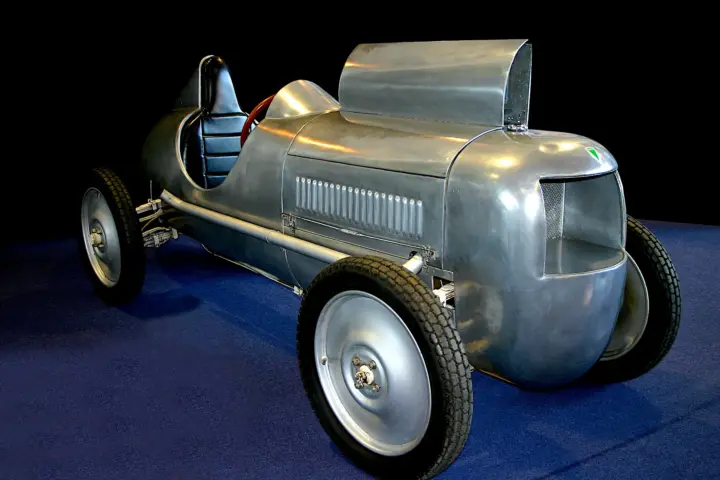
In 1930, DKW launched the F1, the world’s first production car with front-wheel drive. König-Fachsenfeld saw its lightweight steel chassis and two-cylinder two-stroke engine as the foundation for an even more ambitious project: a fully streamlined single-seater (monoposto) designed as a record-breaking car. That same year, his record-breaking cars—based on the DKW—set 12 world records—an extraordinary achievement that brought him fame almost overnight. This 1931 model, with its polished, unpainted aluminum body, enclosed cockpit, and distinctive tail fin for stability at high speeds, is one of the vehicles from that program.
The success did not end there. The racing division of Daimler-Benz took notice of him and commissioned König-Fachsenfeld to design a streamlined single-seater body around the mechanics of the SSKL race car, one that would be suitable for high-speed racetracks such as Berlin’s AVUS. Manfred von Brauchitsch drove the resulting car to victory at the AVUS in 1932. König-Fachsenfeld continued to refine his ideas in the years that followed and, in the late 1930s, eventually produced streamlined record-breaking cars based on the BMW 328, which set speed records on the new German autobahns.
This DKW remains one of the earliest surviving examples of his work, a quiet starting point for a career that shaped German automotive aerodynamics for a generation.