Classic American Trucks & Pickups 1929-1959 – Fine Art Photography
The American pickup truck is one of the most enduring and distinctly national objects that the twentieth century produced. From the late 1920s, when Ford and Chevrolet first began fitting cargo beds to their passenger car chassis, the pickup evolved decade by decade into something far greater than its utilitarian origins suggested, a cultural symbol, a working partner, and eventually an object of genuine beauty that collectors and enthusiasts pursue with the same passion reserved for sports cars and racing machines.
This gallery documents thirty years of that evolution, from the raw, archaic simplicity of late 1920s and early 1930s Ford and Chevrolet trucks through the rounded, chrome-detailed elegance of the postwar golden era and into the confident, muscular designs of the late 1950s. These are not restored trailer queens photographed in studio conditions, they are working survivors, show vehicles, and lovingly maintained classics photographed at events across Germany and the Netherlands by Peter Kraaibeek, often in settings that place American automotive history against a distinctly European backdrop.
The trucks in this collection span the breadth of American commercial vehicle culture: Ford F-series pickups, Chevrolet Advance Design and Task Force trucks, a Studebaker, an International Harvester, a Chevrolet Cab Over Engine, and the 1959 Ford Ranchero, the car that asked whether a vehicle had to choose between being a car and a truck at all. Each is available as a museum-quality fine art print in metal, canvas, and framed giclée. Metal prints are particularly recommended for the chrome, paint, and industrial detail that defines this era.
Pre-War Pioneers – American Trucks of the 1920s and 1930s
The earliest American commercial vehicles were honest machines built for honest work, wooden beds, simple mechanicals, and cab designs that made no pretense of comfort or style. And yet even in this utilitarian era, Ford and Chevrolet were competing for customers, and that competition produced trucks with a raw visual character that builders and collectors have been celebrating ever since. The pre-war Ford and Chevrolet trucks, with their upright cabs, sweeping fenders, and chrome-detailed grilles, are the founding ancestors of everything that followed.
1929 Ford Model A Pickup Hot Rod – Black Primer Flatbed Truck
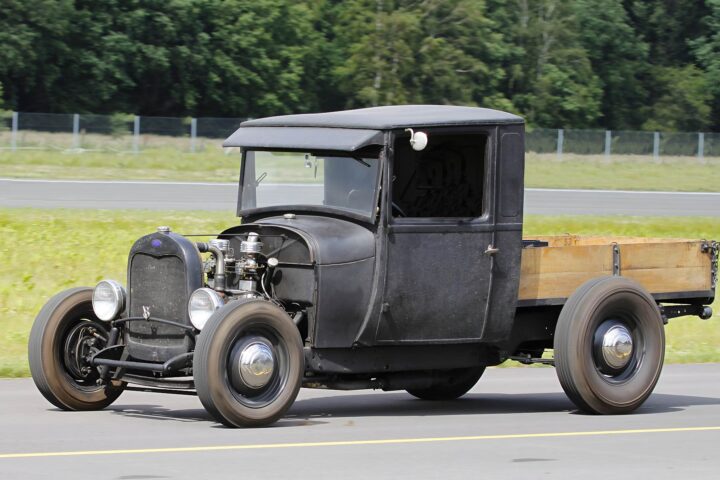
Flat black primer, a V8 conversion under the hood, and a hairpin front axle that drops the nose right down to the tarmac. This Model A pickup wears its traditional hot rod build with zero apologies. Staggered blackwall tires and a raw, unfinished wood flatbed complete the look: nothing polished, nothing pretending. Just proportion, stance, and nearly a century of attitude, caught mid-roll on the tarmac.
1938 Ford Model 81A Pickup – Copper Kustom in Industrial Light
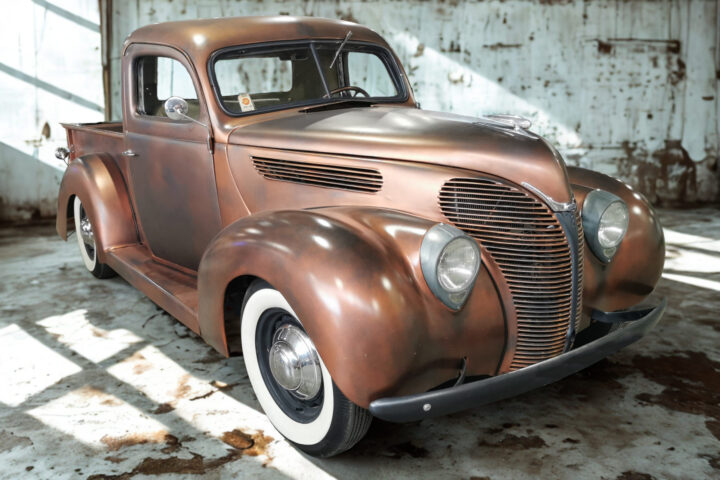
The 1938 Ford Model 81A was one of the last pre-war Ford pickups produced before wartime halted American truck manufacturing, a design refined over nearly a decade into a genuinely elegant working vehicle, with swept front fenders, louvered hood sides, and the iconic horizontal bar grille carrying the center V badge. This example has been transformed into a Kustom build of real ambition: a warm copper metallic finish in satin that shifts from gold to bronze with the light, a lowered stance, whitewall tires, and bodywork smoothed to quiet perfection. It was photographed inside an abandoned industrial building where diagonal shafts of natural light fall across rust-stained concrete, a setting that turns an already exceptional truck into one of the most atmospheric fine art images in this collection.
1941 Chevrolet AK Series Pickup
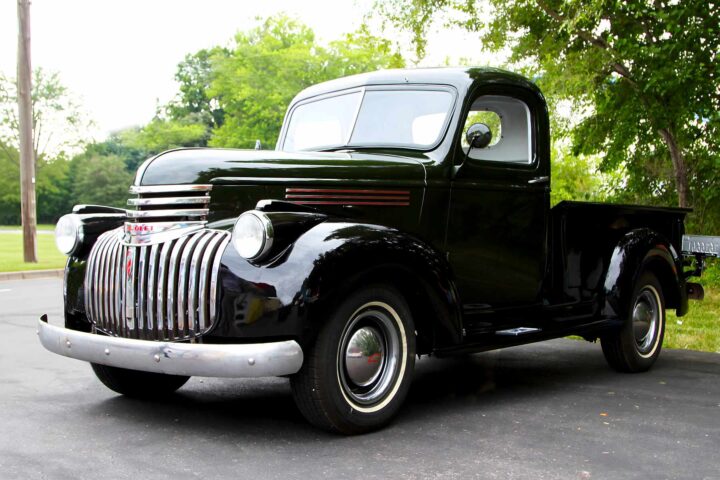
The 1941 Chevrolet AK Series pickup carried one of the most celebrated grille designs in American truck history, a tall, arched waterfall of vertical chrome bars that automotive historians and Art Deco enthusiasts alike cite as a defining example of streamlined-era design applied to a working vehicle. This example wears deep black gloss paint, a subtle red pinstripe on the hood side, and period whitewall tires on chrome hubcaps, restored to show condition throughout. The 1941 AK Series holds a quietly significant place in American history: it was the last full model year of prewar Chevrolet truck production. Pearl Harbor came in December 1941, civilian manufacturing halted, and when trucks rolled again after the war, the chrome waterfall grille design did not come back with them.
1941 Chevrolet Panel Truck – Indian Motorcycle Bonneville Tribute
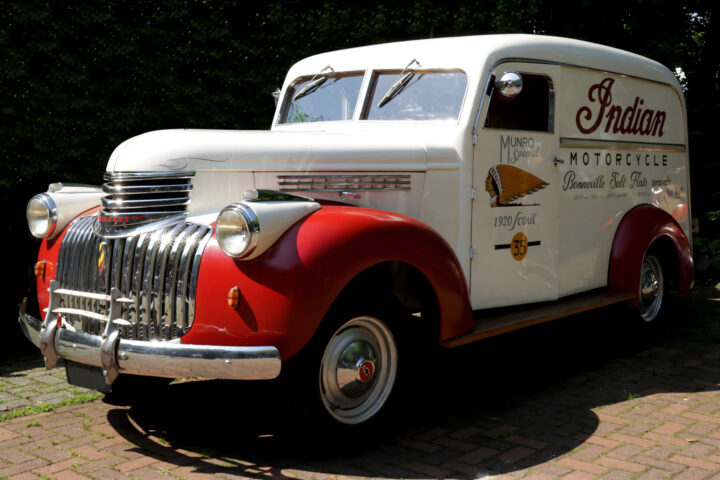
This 1941 Chevrolet half-ton panel delivery truck wears one of the most historically literate liveries found on any classic vehicle today – a tribute to Burt Munro, the New Zealand racer who spent twenty years hand-building modifications to his 1920 Indian Scout motorcycle in a backyard shed before sailing to America to test it against the fastest machines in the world. At age 68, riding the by-then forty-seven-year-old machine he called the Munro Special, he set an official land speed record of 184.087 mph at the Bonneville Salt Flats in 1967, a record that still stands. His extraordinary story became the basis for the 2005 film “The World’s Fastest Indian,” starring Anthony Hopkins. The hand-painted Indian head graphic and sweeping script lettering on this Chevrolet’s red and cream bodywork are period sign-painting craft of the highest order, turning a classic American commercial vehicle into a rolling piece of motorcycle racing history.
Postwar Iron – The Golden Era of American Trucks 1946–1953
When American truck production resumed after the war, it picked up almost exactly where it had left off. The 1946 and 1947 models were barely changed from their prewar predecessors. But the industry moved quickly: by 1947 Studebaker had launched an entirely new modern design, by 1948 Ford had introduced the F-series with its bold new cab-forward styling, and by the early 1950s Chevrolet’s Advance Design trucks had established themselves as some of the most beautiful commercial vehicles ever produced in America. This is the era that defines the classic truck for most collectors.
1948 Ford F-1 – Front View Portrait
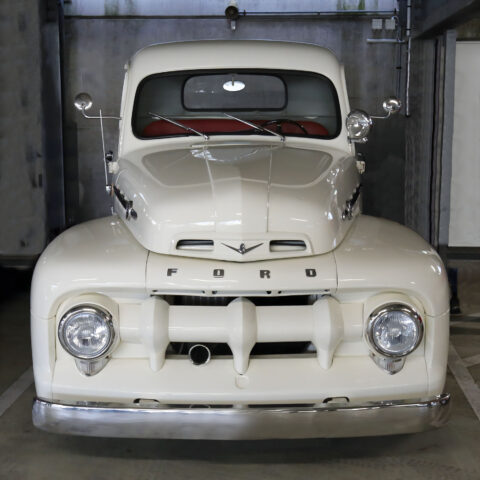
In 1948, Ford launched the F-Series – a completely new, purpose-built truck lineup designed from the ground up for the postwar world. The F-1 was the lightest of the range and the one most American families would recognize, and it arrived with a visual confidence that made it immediately clear Ford’s designers understood they were building something that would last. This example, finished in warm cream with a red interior visible through the wide split windshield, has been restored to show-quality precision, chrome bumper, period mirror stalks, and the V8 hood badge exactly where it should be. Photographed dead-center in a concrete parking garage, it reads less like a car show entry and more like a formal portrait: every line of the original design visible, nothing competing for attention.
The Task Force Era – American Trucks at Their Design Peak 1954–1959
The mid-to-late 1950s brought the full force of American automotive styling ambition to the pickup truck. Chevrolet’s Task Force series (1955–1959) and Ford’s F-100 facelift gave buyers vehicles that were genuinely beautiful as well as capable, with two-tone paint options, panoramic windshields, optional V8 engines, and chrome details that announced the driver had taste as well as practicality. By 1959 the Ford Ranchero was asking whether the pickup even needed to be a truck at all. This is the golden peak of the classic American pickup era.
1947 Studebaker M-Series Pickup – Forest Green Postwar Classic
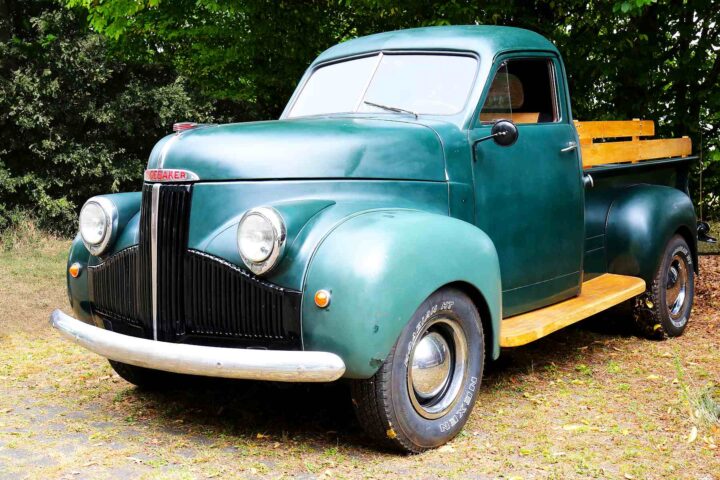
While Ford and Chevrolet dominated the headlines, Studebaker was quietly building some of the most advanced trucks in postwar America. The 1947 M-Series Pickup continued a tradition that Studebaker had begun in 1941, the first American manufacturer to introduce a genuinely modern, aerodynamically considered cab design, more sophisticated than anything its competitors offered at the time and a nice dashboard as well. This example, finished in deep forest green with an honest working patina and fitted with a warm pine flatbed that glows against the dark cab, carries its history with complete unpretentious confidence. The original red Studebaker name badge remains on the vertical grille, a small but satisfying detail on a truck that never needed to shout to make its point.
1953 International Harvester R-110 Series Pickup
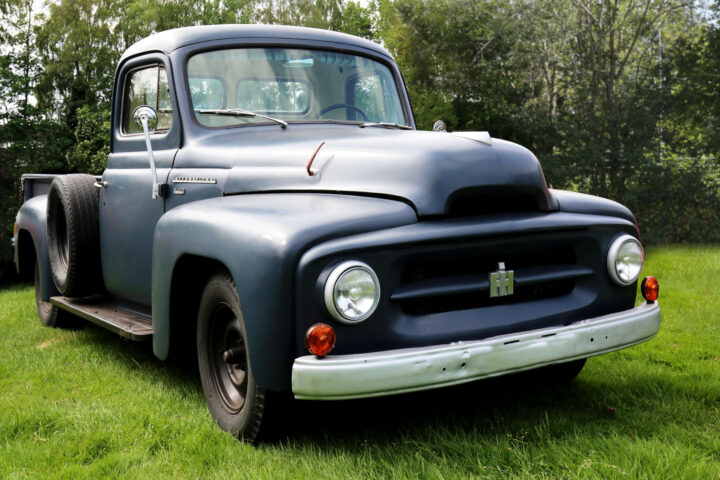
International Harvester introduced the R-Series in 1953 as a comprehensive update of its pickup truck lineup and the R-110 was the light-duty flagship. The most significant change was the new grille: a clean rectangular opening with the iconic IH double-H “tractor” logo placed prominently in the center, a badge borrowed from the company’s agricultural machinery heritage and worn here with characteristic understatement. Under the hood sat the Silver Diamond 220 cubic-inch inline-six, a 100-horsepower engine that collectors still celebrate for its durability, mated to a three-speed manual transmission. This example wears a flat slate blue-grey finish that gives it a working-truck honesty distinct from the gloss restorations that dominate classic truck shows, exterior chrome used only where the design genuinely needed it, exactly as International Harvester intended.
1955 Ford F-100 – Sky Blue American Classic on German Cobblestones
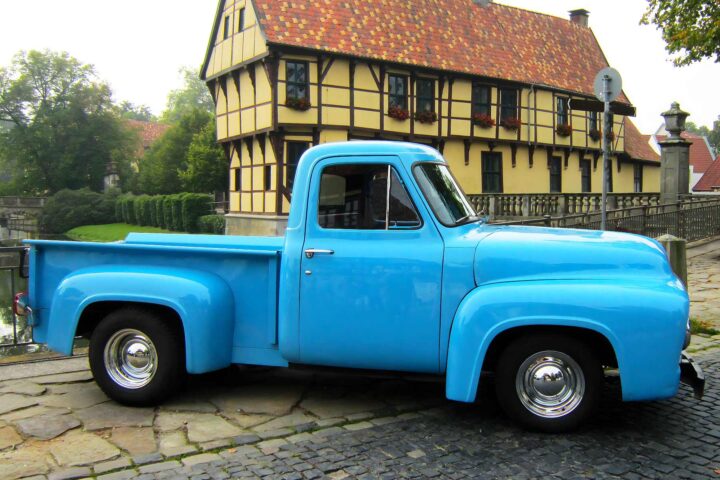
The 1955 Ford F-100 arrived with a significant evolution over its predecessors, a new one-piece windshield, a revised front end wearing the V8 badge with quiet pride, and a design confidence that made it the most stylish pickup truck of its era. Ford sold over 124,000 F-Series trucks in 1955, beginning a sales record that has never been broken. This example, finished in a sky blue that catches every nuance of available light, was photographed in a German old town, with cobblestones underfoot, a traditional Fachwerkhaus and a medieval Schloss tower providing a backdrop that its Detroit designers could never have imagined. It carries a German historic vehicle registration and looks entirely at home. Both a side profile and a front three-quarter view are available as fine art prints.
1959 Ford Ranchero – Two-Tone Classic Coupe Utility
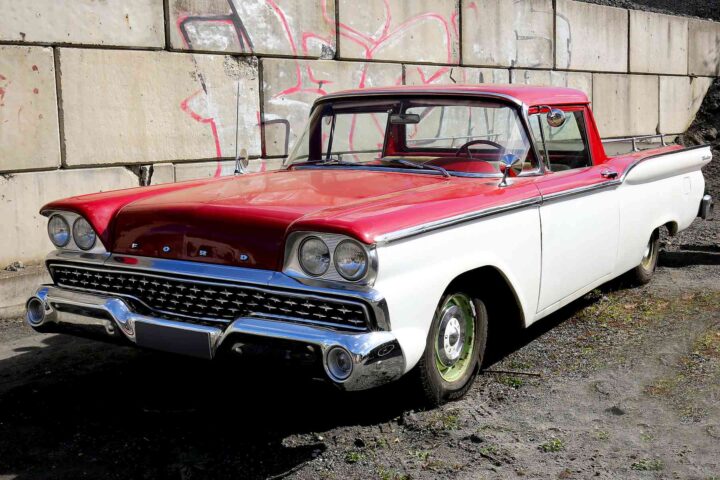
Ford introduced the Ranchero in 1957 as America’s first car-based coupe utility, the question of whether a vehicle could be both a stylish passenger car and a practical working truck, answered with a resounding yes. By 1959 the first generation had reached its design peak: two-tone bodywork in red and cream, swept tailfins carrying the spirit of the jet age, and a long low silhouette that gave it the presence of a full-size American car in every setting. The Ranchero never pretended to be a workhorse, it was a statement, and it made that statement beautifully. Both the full vehicle and a close-up fine art detail of the distinctive stacked taillight chrome assembly are available as fine art prints.
More Classic American Truck Photography Coming Soon
This gallery is an ongoing project. Peter Kraaibeek continues to document exceptional examples of classic American trucks and pickups at events across Germany and the Netherlands. New photographs will be added as the collection grows. Bookmark this page and return to discover the latest additions.
Every image in this gallery is available as a museum-quality fine art print through Fine Art America in a wide range of sizes and materials, including metal prints, canvas, and framed giclée. Metal prints are particularly recommended for the chrome grilles, painted bodywork, and industrial detail that define the trucks of this era. Photographs from the collection are also available on apparel, phone cases, and accessories through Redbubble and Teepublic.