Kustom Kulture – Hot Rods, Rat Rods, Lead Sleds & Street Rods
There is a corner of American automotive culture that was never about factory showrooms or engineering departments. It grew up in California garages, on dry lake beds, and along the cruise strips of a post-war nation flush with cheap steel, surplus parts, and restless energy. It had its own spelling, its own rules, and its own visual language and it produced some of the most striking and influential machines ever to roll on four wheels.
Kustom Kulture, with its deliberately misspelled name, was a declaration of independence from the mainstream. Beginning in the late 1930s and exploding through the 1940s and 1950s, it was a movement built by people who believed a car was not finished when it left the factory, it was only just started. Customizers, rodders, and builders took production vehicles and reimagined them entirely, chopping rooflines, channeling bodies, sectioning hoods, shaving door handles, molding sweeping bodywork from lead and filler, and painting everything in deep, lacquered candy colors or deliberately worn, weathered finishes. The result was not a car, it was a statement.
Hot Rods emerged from a simple ambition: go faster. Early hot rodders stripped weight, raised compression ratios, bored out flathead V8s, and raced on the dry lakes of the Mojave Desert long before purpose-built drag strips existed. Speed was the goal, but visual drama followed naturally, raked stances, exposed engines, minimal bodywork, and an aggressive, stripped-back aesthetic that became a defining look.
Rat Rods took the same spirit in a darker, more theatrical direction. Where the show rod tradition elevated the car to a polished, almost untouchable art object, the Rat Rod embraced rust, patina, improvisation, and the deliberate exposure of mechanical guts. Rat rods looked like they had been assembled from a scrapyard in an afternoon and that was entirely the point. They celebrated imperfection, ingenuity, and the subversive pleasure of making something remarkable from almost nothing.
Lead Sleds represented Kustom Kulture’s most sophisticated and painterly expression. Named for the lead body filler used to reshape and smooth metal, these heavily customized machines, like Mercurys, Buicks, Fords, and Chevrolets, were lowered, chopped, channeled, and reshaped until their original identities were almost unrecognizable. The work of legendary customizers such as George Barris, Sam Barris, Joe Balcaen, and the great Gene Winfield turned ordinary production cars into flowing, almost organic sculptures. Nowhere was the connection between automotive customization and fine art more evident than in the leadsled tradition.
Street Rods occupy the most refined end of the hot rod tradition. Where the hot rod pursues raw performance and the rat rod celebrates honest imperfection, the street rod pursues perfection itself, every panel smoothed, every seam dissolved, every detail considered until the car reads as a single, unified form. Street rods draw from the same prewar Ford and Chevrolet platforms as the hot rod movement, but the builder’s ambition points toward show-quality finish and visual sophistication rather than quarter-mile times. The 1932 Ford Deuce and the 1933 Ford cabriolet are the two most celebrated street rod platforms in the tradition, and both appear in this gallery, representing opposite ends of the same cultural continuum.
This gallery documents some of the finest surviving examples of Kustom Kulture, photographed by Peter Kraaibeek at classic car events in the US, Germany and the Netherlands. Each image is available as a museum-quality fine art print – a chance to bring one of the most creative and rebellious chapters in automotive history directly onto your wall.
The Foundations of Kustom Kulture – Pre-War Iron and Post-War Vision
The earliest hot rods and kustoms drew from the American car industry of the 1930s, a period when factory bodywork was already bold and sculpturally confident. Builders took these strong foundations and pushed them further, lowering, chopping, and modifying until something entirely new emerged from the old steel.
1929 Ford Model A Tudor Hot Rod
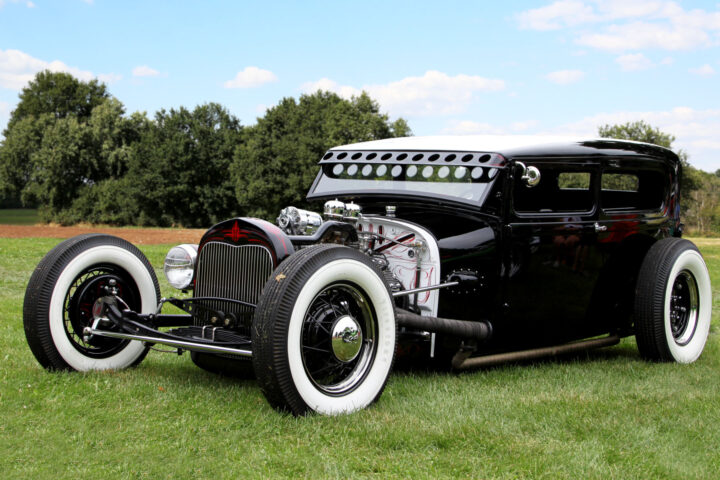
Henry Ford built over four million Model A Tudors between 1928 and 1931, making them the most abundant and affordable prewar chassis available to the postwar hot rod builders who transformed American car culture in the late 1940s. This example honors that founding tradition at every point: the top chopped low and fitted with a drilled header visor, the engine sitting completely exposed ahead of the firewall with chrome valve covers and carburetor catching the sun, a dropped I-beam front axle bringing the nose to the grass, and wide whitewall tires on chrome spoke wheels. Red pinstripe flames on the white hood panels are hand-applied with show-quality craft. Mirror-black gloss paint throughout reflects the green of the field it stands in, a perfect three-quarter portrait of traditional hot rod culture at its most complete.
1932 Ford Deuce Roadster
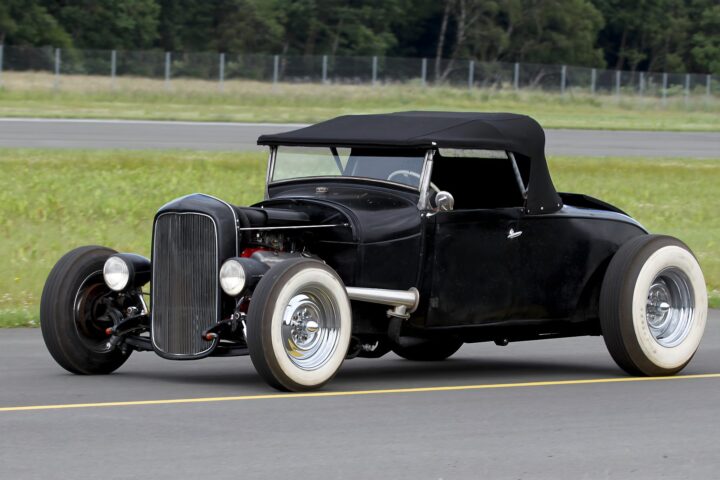
The 1932 Ford – the Deuce – is the single most important platform in American hot rod history. When Ford introduced its first affordable flathead V8 that year, it handed a generation of builders exactly the engine and chassis they needed: lightweight, naturally low, and blessed with proportions that respond to modification as though the original designers anticipated the hot rod movement themselves. This example makes no concessions to comfort or restraint — all-black satin finish, dropped straight front axle, red-painted flathead V8 breathing through chrome intakes, and a frame-rail exhaust pipe running openly along the chassis. Photographed rolling on a European airstrip, it is the traditional hot rod in its most direct and uncompromising form.
1933 Ford Cabriolet Street Rod
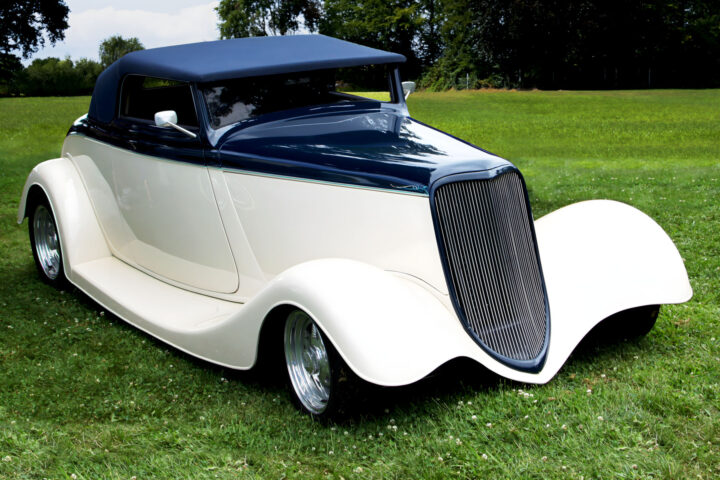
Alongside the 1932 Deuce, the 1933 Ford cabriolet is one of the acknowledged icons of the American street rod tradition, its sweeping front fenders, naturally low proportions, and upright vertical-bar grille providing a foundation that responds to skilled metalwork like few other prewar designs. This example takes that foundation and builds on it with complete precision: every exterior panel smoothed, sectioned, and reshaped until the car reads as a single uninterrupted form from fender tip to rear quarter. No seams, no trim, no chrome anywhere the design didn’t genuinely earn. The two-tone finish – cream below, a deep navy blue above, meeting in a razor-clean line that continues through the matching soft top – gives the build a visual sophistication that sits closer to coach-built elegance than to raw hot rod attitude.
1938 Buick Eight Rat Rod
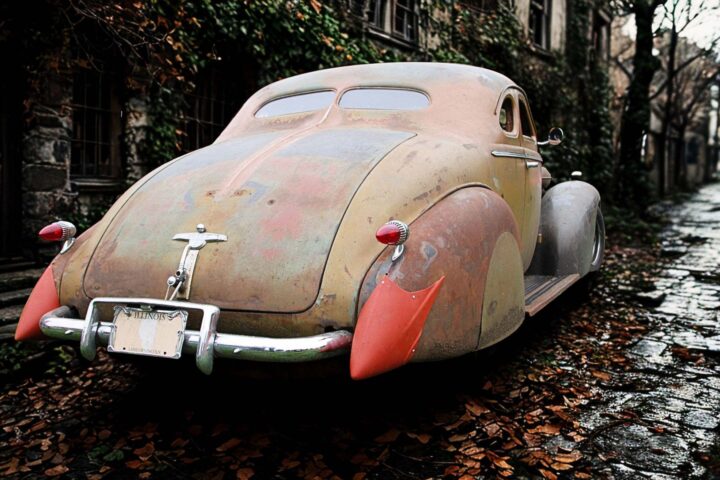
The 1938 Buick Eight was already a striking machine when it rolled out of Flint, Michigan, long, low, and built with a confidence that only Buick in the late pre-war years could project. This Rat Rod interpretation strips the Buick back to its essential character: raw steel, patinated surfaces, and a deliberately unfinished quality that makes every design detail of the original bodywork read with surprising clarity. The sweeping front fenders, the waterfall grille, and the long bonnet line all survive, but the surrounding context has been transformed. What remains is something closer to a moving sculpture than a restored automobile: brutal, honest, and entirely captivating.
1950 Mercury Kustom
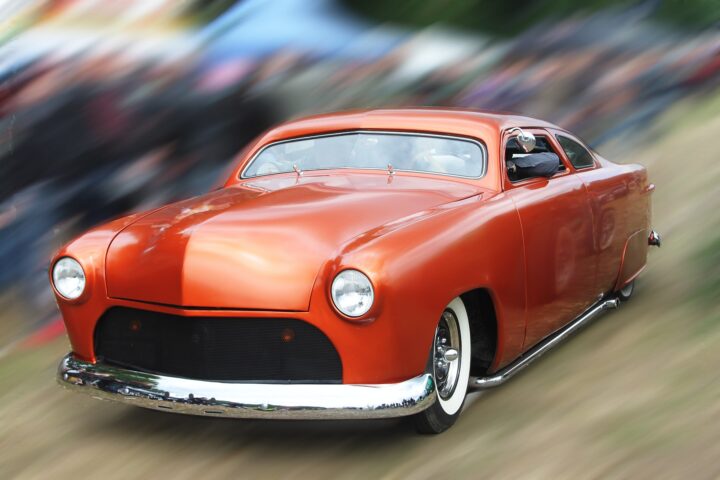
No single model is more closely identified with the Lead Sled tradition than the 1949 – 1951 Mercury. With its already-low roofline, flush bodywork, and smooth flanks, the postwar Mercury was practically begging to be customized, and thousands were. This example carries the hallmarks of traditional Merc kustom work: a chopped top that draws the roofline down into a long, menacing horizontal, shaved trim, and bodywork smoothed and reshaped until the seams and joints disappear into one continuous form. The Mercury Kustom is arguably the single most important canvas in the history of American custom car culture, and this example demonstrates exactly why.
1948 Ford Coupe Deluxe – Show Rod Kustom

By the late 1940s, the most ambitious customizers were no longer simply modifying production cars, they were dissolving them. This 1948 Ford Coupe Deluxe represents that ambition taken to its logical extreme: every external surface has been reshaped, smoothed, and resolved until the original bodywork survives only as a distant memory beneath the candy tangerine paint. The windshield and rear glass are tunneled flush into the roofline, the wheel openings are fully skirted and frenched into the body, all trim is shaved to bare metal, and the whole form sits so low on its air suspension that it appears to grow directly from the floor. What remains is not a modified Ford, it is a piece of sculpture that once happened to be one.
1950 Ford Shoebox Kustom
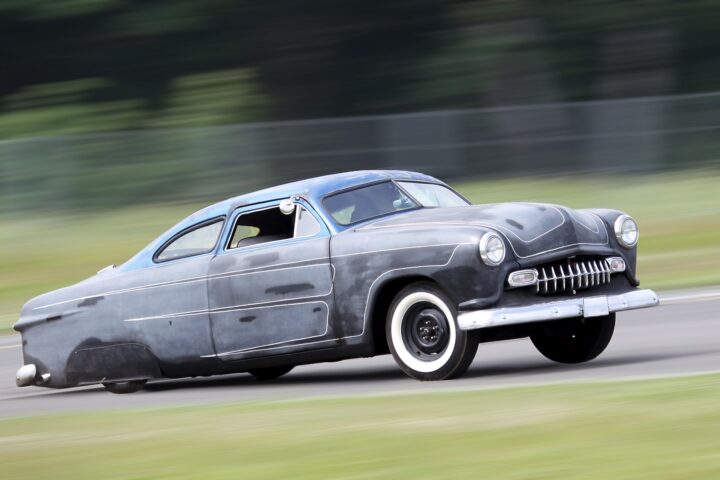
The Ford Shoebox (so called for the squared-off, slab-sided body that Ford introduced for 1949) was the affordable alternative to the Mercury for budget-conscious customizers, and it proved just as rewarding a starting point. Clean, flat panels invited lead-filling and reshaping. The low, wide stance responded perfectly to a mild chop and a drop. This kustom example demonstrates the timeless appeal of the Shoebox formula: elegant proportions, minimal ornamentation, and a stance that sits low and purposeful against the road. Where the Buick above celebrates raw mechanical character, the Ford Shoebox Kustom favors smooth confidence, two different answers to the same Kustom Kulture philosophy.
Hot Rods and Gassers – Speed, Attitude and the American Quarter Mile
If Kustom Kulture was about reshaping a car into rolling sculpture, Hot Rod culture was about something rawer and more immediate: performance. Hot rodders and drag racers shared the same garages and the same reverence for American V8 iron, but their ambitions pointed toward the strip rather than the show field. These machines were built to go fast, and they looked every inch the part.
1937 Ford 5-Window Coupe – Blown Hot Rod

The 1937 Ford 5-Window Coupe is one of the founding icons of American hot rod culture. Its swept front fenders, rounded roofline, and compact proportions have made it a builder’s first choice since the 1940s, when early rodders discovered that the pre-war Ford’s light body and strong frame responded beautifully to a big V8 and a pair of drag slicks. This example takes the tradition further still: a supercharger punches straight through the bonnet and the whole machine moves down a European airstrip with the focused energy of something built for one purpose only. Decades on, the formula still works.
1941 Willys Coupe Pro Modified – SuperPro ET
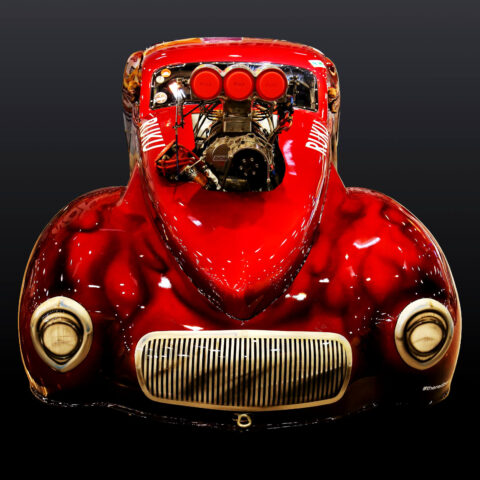
The 1941 Willys Coupe became the defining body of the American Gasser class in the 1960s, its upright windshield and lightweight construction making it the ideal candidate for straight-axle drag racing. This example shows where six decades of development took that tradition. The hood area has been redesigned as an open engine display: Three FLEX carburetors, clearly visible, sit atop a large-displacement V8 engine. The original Willys grille remains at the front, chrome, vertical-barred, period-correct, as a deliberate acknowledgment of the car’s origins. Candy red paint shifts from deep burgundy to vivid scarlet over ghost flames airbrushed into the lower panels, photographed front-on against a dark gradient that lets the paint blaze with its full extraordinary depth.
1946 Ford Super Deluxe Coupe Gasser
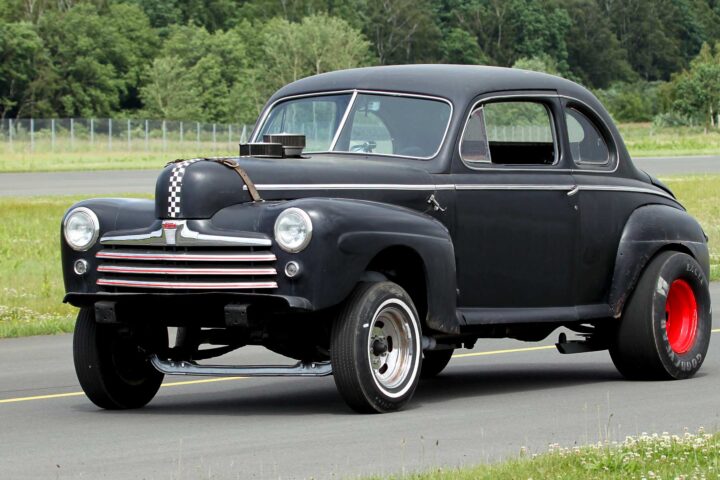
Most Gasser builders chose Willys coupes or early 1950s compacts for the lightweight bodies and high rooflines the class favored. The 1946 Ford Super Deluxe Coupe is a rarer choice, its longer, more aerodynamic postwar body creating a distinctive silhouette that makes NHRA history fans look twice. This example, running in the Small Block class, is a genuinely raced vehicle photographed on a European airstrip: the checkered hood graphic, the Goodyear drag slicks on red rear wheels, and the straight front axle lifting the nose into the unmistakable Gasser stance all earned at the strip rather than applied for show.
1964 Dodge Dart Gasser – NHRA Drag Racing Legend
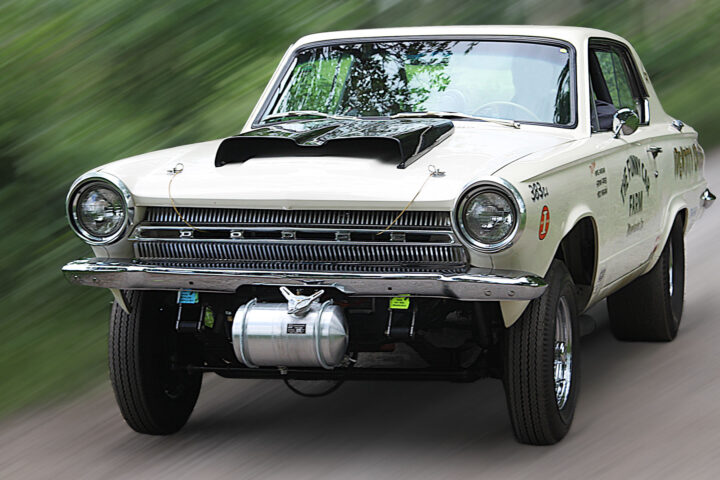
The Gasser class was the defining spectacle of NHRA drag racing throughout the 1960s, and no detail defined it more immediately than the stance: front axle replaced with a straight solid unit, nose raised high, rear haunches low and heavy with the engine’s torque. The 1964 Dodge Dart was a natural Gasser platform, light, compact, and with a Mopar V8 that rewarded every modification thrown at it. This example, running with 323 cubic inches, is a period-correct tribute to that era, aluminium tank mounted under the chrome bumper, functional hood scoop, and the whole machine caught head-on in a panning shot that puts you directly in its path.
More Kustom Kulture Photography Coming Soon
This gallery is an ongoing project. Peter Kraaibeek continues to document exceptional examples of Hot Rods, Rat Rods, Lead Sleds, Street Rods, and Kustom Kulture vehicles at classic car events across Germany and the Netherlands. New photographs will be added to this page as the collection grows. Bookmark this page and return to discover the latest additions.
Every image in this gallery is available as a museum-quality fine art print through Fine Art America in a wide range of sizes and materials, including metal prints, canvas, and framed giclée. Metal prints are particularly recommended for the high-contrast, dramatic character of Kustom Kulture photography.