American Tailfins & Taillights – The Chrome Age in Detail
There has never been a decade in automotive history quite like it. Between 1954 and 1963, American car designers took their cue from jet fighters, rockets, and science fiction and produced rear-end styling of a confidence and extravagance that the world had never seen and has never repeated. Tail fins rose from gentle suggestions to soaring vertical monuments. Taillights evolved from simple red lenses into chrome-wrapped bullet shapes, stacked triples, and glowing panoramic bars. Every year, every manufacturer, every model year brought a new answer to the same question: how far can we go?
This gallery brings together twenty-five of the finest and most distinctive examples from that extraordinary era, photographed in intimate, close-up detail by Peter Kraaibeek to reveal the artistry, the craftsmanship, and the sheer visual invention that most admirers never get to examine this closely. From the earliest stirrings of the tailfin on a 1954 Oldsmobile Rocket 88 to the quiet, nearly fin-free elegance of a 1963 Mercury Comet, this is the complete arc of one of design history’s great adventures.
Every photograph in this collection is available as a museum-quality fine art print. Nothing tells the story of this era quite like seeing it on your wall, full size, in every detail.
🎨 Experience the Exhibition
Tailfins & Taillights – Beyond the Photographs
Discover this collection in two additional ways:
🚶 Visit the Interactive Virtual Exhibition (Free Admission)
Step inside the KRAAIBEEK ART GALLERY and explore the photographs in a fully immersive virtual exhibition. Walk through the gallery at your own pace and experience the iconic tailfins and taillights of America’s golden automotive era.
👉 Enter the Virtual Exhibition (free):
https://visit.virtualartgallery.com/american-tailfins-taillights
▶️ Watch the Exhibition Tour on YouTube
Prefer a guided experience? Enjoy a professionally produced exhibition tour featuring highlights from the gallery, accompanied by music and carefully selected camera movements.
👉 Watch the Exhibition Tour:
https://youtu.be/V5MWXK3UdHc
The Birth of the Fin – Early Fins & Rising Chrome (1954–1956)
The tailfin did not appear overnight. It arrived gradually, almost tentatively, in the early 1950s, a whisper of the jet age at the rear corners of America’s most forward-looking cars. Inspired by the twin-boom fuselage of the Lockheed P-38 Lightning and the swept lines of early jet aircraft, designers began to lift the rear fenders, sharpen the taillights, and dream of the sky. The five cars in this group represent that first, formative chapter, each one pointing unmistakably toward everything that was about to happen.
1954 Oldsmobile Rocket 88
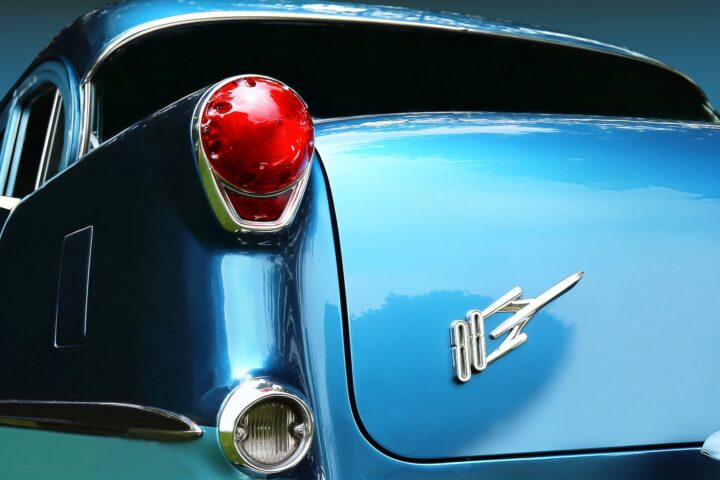
The Rocket 88 was one of the earliest American production cars to incorporate the rising rear fin treatment that would define the following decade, and its name, borrowed from its legendary high-compression V8, tells you everything about the spirit behind the design. The fins here are still gentle, the chrome still restrained, but the direction of travel is unmistakable. This photograph captures a pivotal moment in automotive design history: the tailfin at its very beginning.
1954 Cadillac Fleetwood Series 60 Special
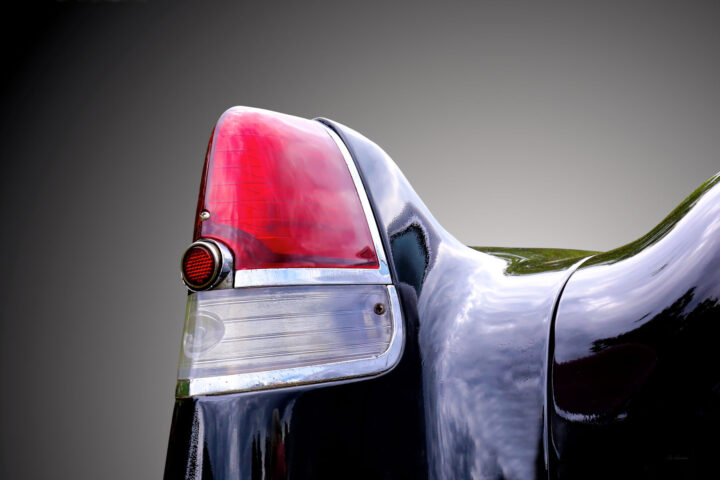
Cadillac had been quietly developing the tailfin concept since 1948, when designer Frank Hershey first drew inspiration from the Lockheed P-38 fighter plane — making Cadillac the true originator of the tailfin era. By 1954 those fins were growing with visible confidence, the twin chrome taillights gleaming with the authority of a brand that knew it had started something significant. This photograph of the Fleetwood Series 60 Special documents the tailfin story at the hands of its inventor.
1955 Chevrolet Corvette C1
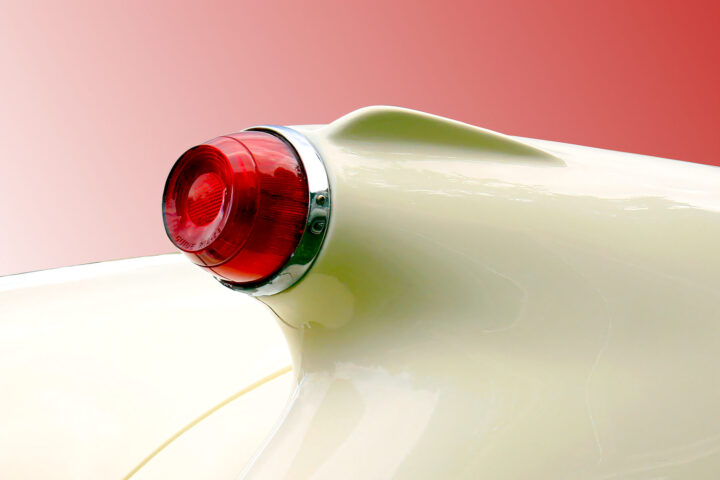
The C1 Corvette approaches the tailfin language from a completely different direction, restrained, almost European, more concerned with elegance than spectacle. The curved rear fenders and chrome-ringed taillights suggest speed without excess, a counterpoint to the flamboyance developing around it. This photograph captures the rear detail of an American sports car icon at the dawn of its story, and it is one of the subtlest and most refined images in this entire collection.
1956 Pontiac Chieftain 870 Wagon

Station wagons are rarely considered prime candidates for tailfin photography, but the 1956 Pontiac Chieftain 870 Wagon makes a compelling argument otherwise. The extended roofline and long body create a completely different visual rhythm for the rising rear fins, the horizontal sweep of the wagon amplifying the vertical drama of the fenders and lights in a way no coupe or sedan can match. This is one of the most unexpected and visually compelling perspectives in the collection.
1956 Cadillac Eldorado Biarritz
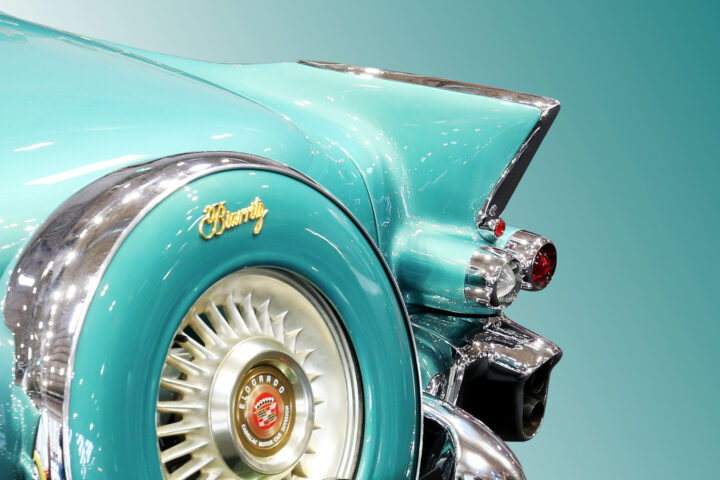
Only 532 were built. At $6,556 – more than three times the price of a standard Cadillac – the 1956 Eldorado Biarritz Convertible was the most exclusive American automobile of its year, and every detail reflected that ambition. The sabre-spoke Eldorado wheel cover with its Cadillac crest medallion center, the chrome-rimmed rear fender skirt, the gold “Biarritz” script badge named for the French Basque resort where European elegance and American money had always felt at home, all of it specified at a level beyond the regular production car. This photograph captures those details in a near-monochromatic aqua and teal composition that reads as abstract art before it reads as a car, the chrome fin rising above twin red taillight lenses as the only warm notes in an otherwise perfectly cool palette.
1956 Lincoln Premiere
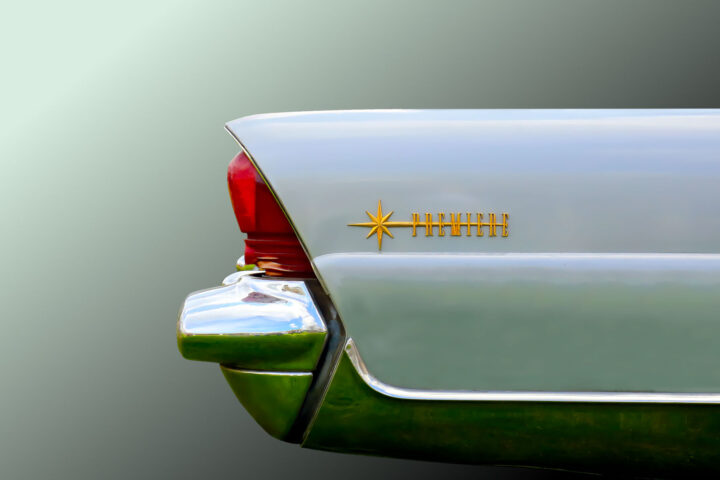
Lincoln entered the tailfin era with the restraint and authority that befitted America’s most prestigious nameplate. The 1956 Premiere’s rear treatment is defined by its refinement — longer, lower, and more architecturally considered than the exuberance being produced across town at General Motors. The gently rising fins and precisely placed chrome taillights speak of a different kind of American ambition: one that preferred distinction to drama.
The Year the Fin Found Itself – 1957
If any single model year defines the tailfin era in popular memory, it is 1957. General Motors, Ford, and Chrysler all produced their most visually exciting designs simultaneously, competing across every price point for the most dramatic rear treatment on American roads. Chrome was everywhere, fins were rising fast, and the confidence of postwar American design was at its absolute height. The four cars in this group represent that single, extraordinary year from four completely different perspectives.
1957 Chevrolet Bel Air
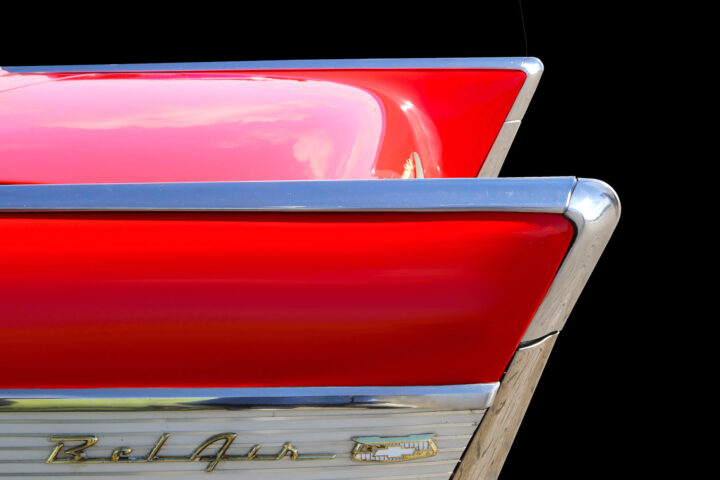
The 1957 Chevrolet Bel Air appears for the second time in the Kraaibeek Art collection, the rear seen from the side this time, where the car reveals an entirely different dimension of its beauty. The twin chrome taillights set into the rising fin, the wide chrome strip across the trunk, and the two-tone body treatment seen from this angle are as composed and confident as anything Detroit produced that year. A different view of the same legend and equally essential.
1957 Ford Fairlane 500
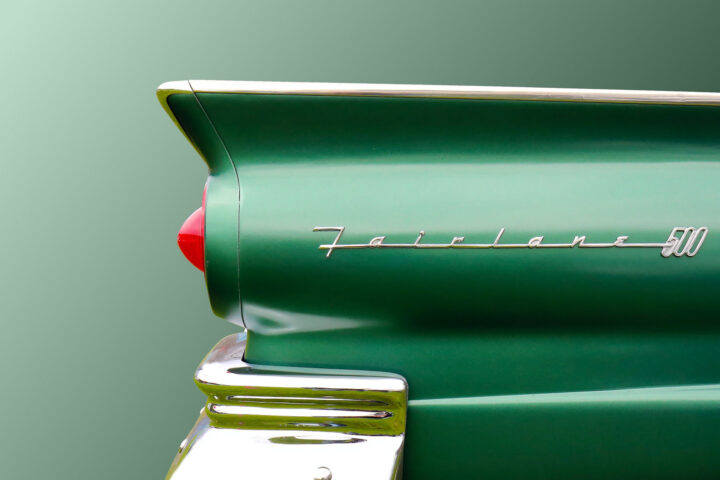
A second rear-view appearance too for the 1957 Ford Fairlane 500, whose swept fins and chrome-framed round taillights are every bit as dramatic from the outside as the cockpit is from within. The wide stance of the Fairlane’s tail, the twin taillights each set within their own chrome housing, and the full-width chrome bumper create a rear composition of real power and elegance. Ford at its finest year, seen from its finest angle.
1957 Buick Century
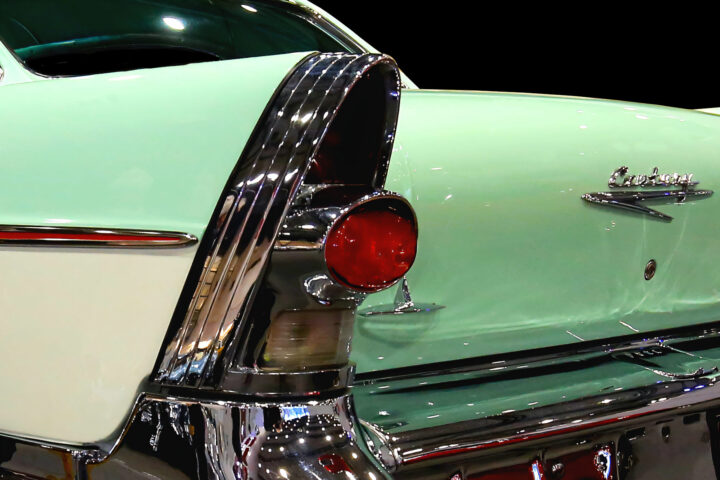
The 1957 Buick Century is defined from any angle by its famous sweep spear — the chrome accent line that runs the full length of the body and terminates at the rear in a chrome flourish that frames the taillight perfectly. The fin itself is more contained than Cadillac’s or Chrysler’s contemporary efforts, but the overall composition of the Century’s rear is one of the most balanced and visually satisfying of the entire tailfin era. This is restraint applied with absolute confidence.
1957 Cadillac Coupe de Ville Series 62
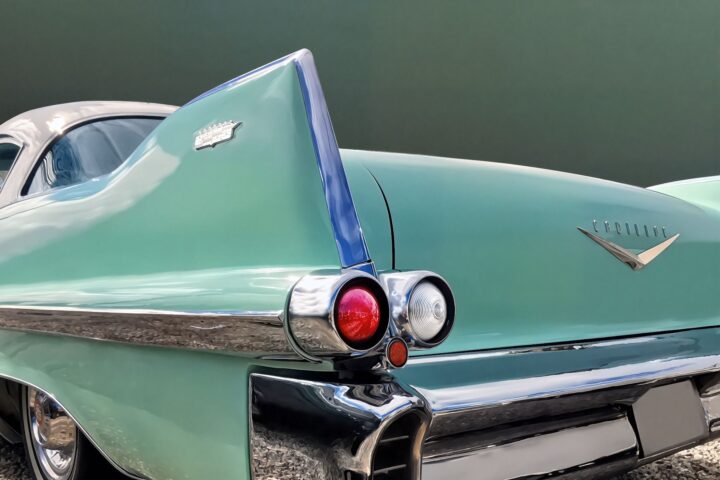
By 1957, Cadillac’s fins were approaching their definitive form — taller, sharper, and more missile-like than anything else on American roads, the twin bullet taillights already anticipating the full rocket-ship styling that was two years away. The 1957 Coupe de Ville Series 62 captures the tailfin story at its most dramatic turning point: confident enough to be extraordinary, not yet extreme enough to be unrepeatable. This photograph marks that precise, pivotal moment.
The Fin Reaches Its Peak – Maximum Chrome (1958–1961)
Between 1958 and 1959, the American tailfin reached heights – literal and figurative – that no production car has approached before or since. Fins became vertical monuments. Taillights multiplied into triples and became chrome-mounted bullet shapes. Chrome spread across every available surface. The eight cars in this group document the absolute apex of this extraordinary design movement, including what remains the most iconic rear-end design in automotive history: the 1959 Cadillac.
1958 Chevrolet Impala Bel Air
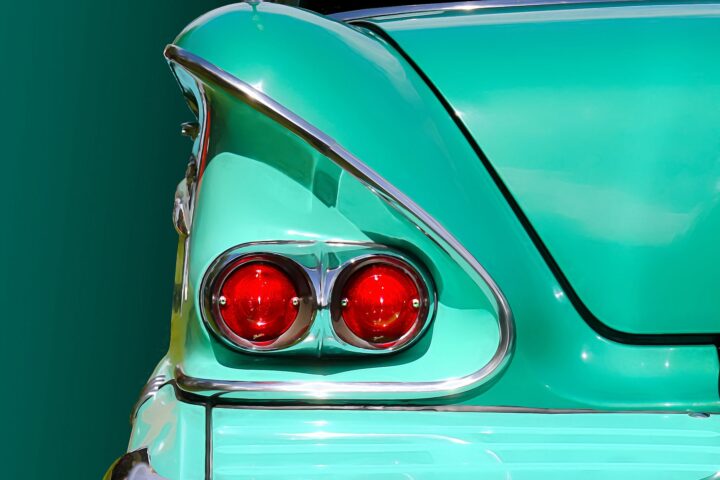
Introduced as the top trim level of the 1958 Bel Air range, the Impala arrived with some of the most extravagant rear styling General Motors had ever produced, a full-width chrome rear treatment that made the car’s tail an event in itself. This photograph captures that excess in all its confident, chrome-heavy glory, and it is one of the most visually complex images in the collection.
1958 Dodge Custom Royal
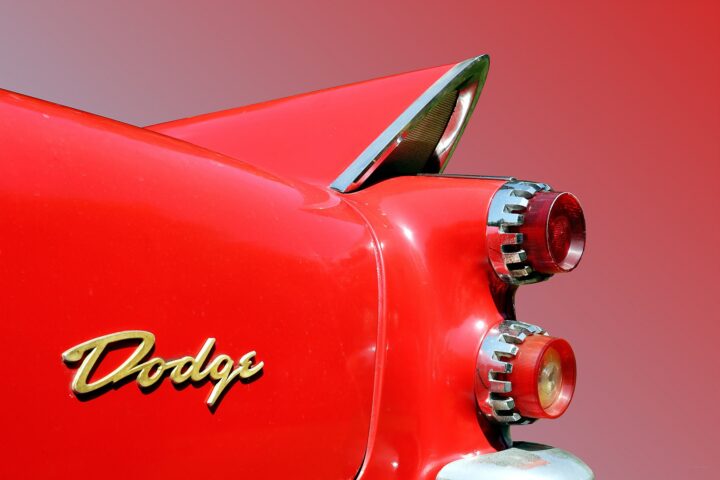
By 1958 the tailfin had abandoned all restraint. The Custom Royal’s rear quarter carries a sharp chrome fin spear that rises like something borrowed from a jet fighter’s tail assembly, paired with stacked twin taillights ringed in scalloped chrome and finished with two distinct lens colors, a deep red above a warm amber below. The gold script “Dodge” badge anchors the composition beneath all that drama. Four years on from the tentative first fins of 1954, this is the tailfin era at its most confident and unapologetic.
1958 Oldsmobile Super 88
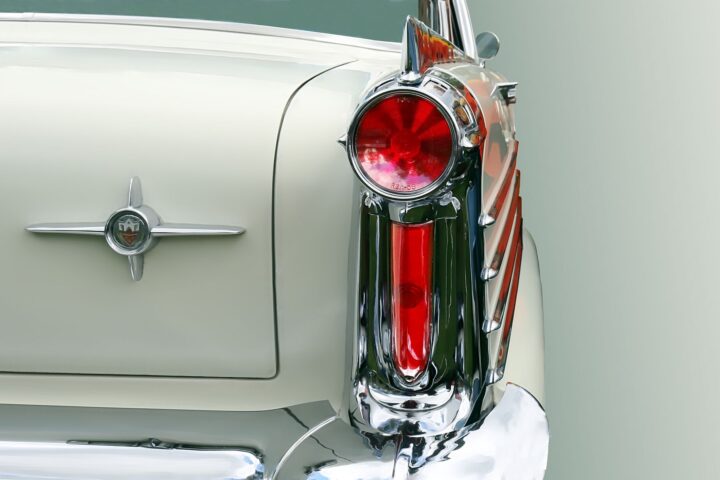
The 1958 Oldsmobile Super 88 received a complete restyle that year, wider, lower, and equipped with some of the most dramatic rear fins in Oldsmobile’s history. Twin taillights mounted within chrome-ringed fins sweep upward in a sharp, purposeful arc that balances aggression with precision. The 1958 Super 88 is one of the great underappreciated designs of the entire tailfin era, and this photograph gives it the close attention it has always deserved.
1958 Pontiac Bonneville
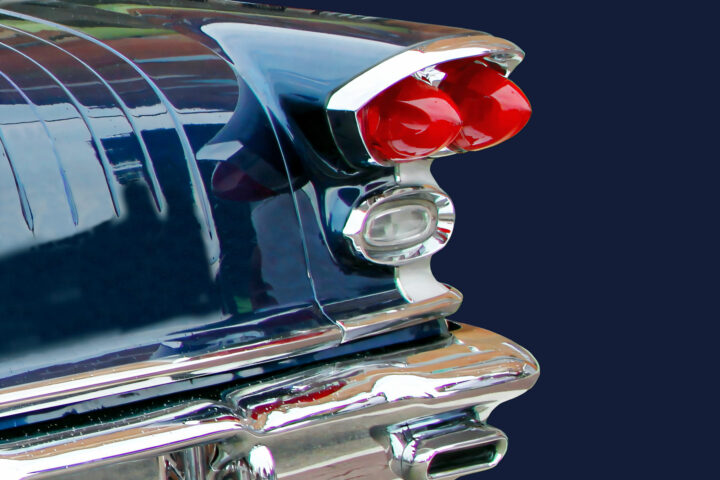
The 1958 Pontiac Bonneville was Pontiac’s first year offering the name as a full production model, and it arrived with a rear design as bold as its ambitions — wide, low, and finished with chrome in every direction. The split taillight treatment, the dramatically finned rear quarters, and the wide chrome bumper treatment established the Bonneville’s visual identity as Pontiac’s flagship from the very first day. This is a rear-view study in the confidence of a brand at the top of its game.
1958 Mercury Monterey
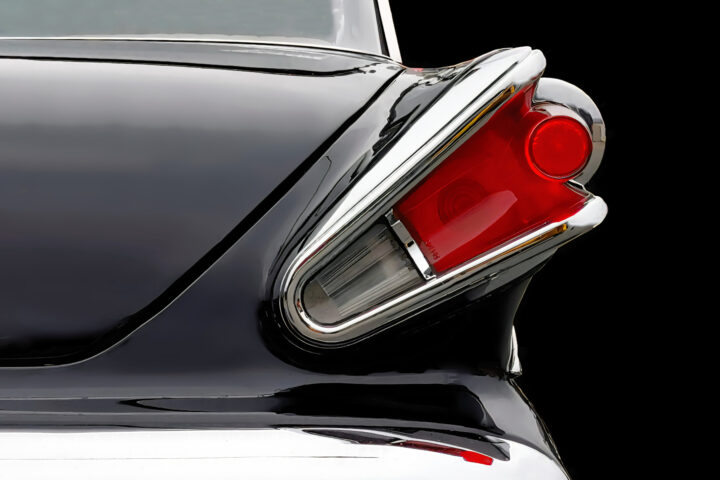
Ford’s Mercury division contributed some of the decade’s most underappreciated tailfin designs, and the 1958 Monterey is a prime example. The horizontal chrome fin line, the round taillights, and the complex rear body treatment represent a considered, disciplined approach to the fin formula – more restrained than Chrysler’s Forward Look, more dramatic than Ford’s own offerings. The Monterey found an elegant middle ground that rewards careful study.
1959 Dodge Custom Royal
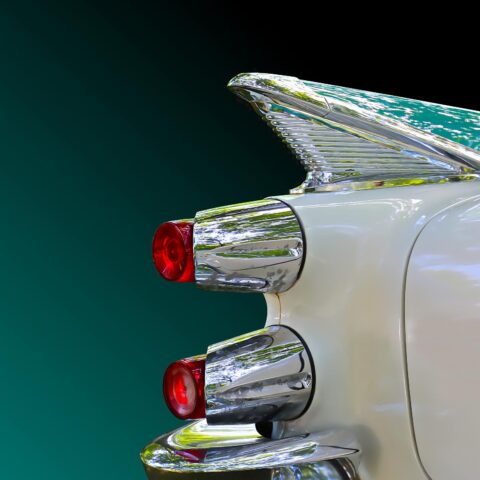
By 1959, the Dodge Custom Royal’s rear quarter had moved beyond mere decoration into something closer to sculpture. Two chrome bullet pods, ribbed, cylindrical, projecting from the white bodywork with aerospace precision, carry the twin red taillight lenses that anchor the whole composition. Above them, a chrome fin spear rises to a swept point, its surface reflecting shifting tones of teal and gold. This close-up photograph isolates those three elements against a teal-to-black gradient that amplifies the cool, otherworldly quality of the chrome and makes the red lenses read as vivid jewels set into an achromatic composition. A companion piece to the 1958 Dodge Custom Royal tailfin image, two consecutive years of the same design philosophy at its most confident.
1959 Ford Ranchero
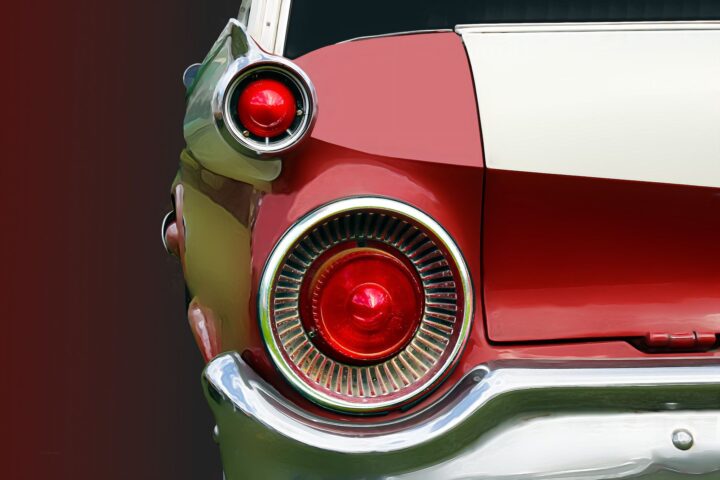
The 1959 Ford Ranchero occupies a position unlike any other car in this collection, a car-truck hybrid built on the Ford Fairlane platform, whose combination of full-width tailfins and open cargo bed creates one of the most unusual silhouettes of the entire era. The fins and chrome taillights are standard Ford issue, but set against the flat plane of the truck bed, they take on a completely different visual character. There is nothing quite like this rear view anywhere else in American automotive design.
1959 Chrysler Imperial Crown Southampton
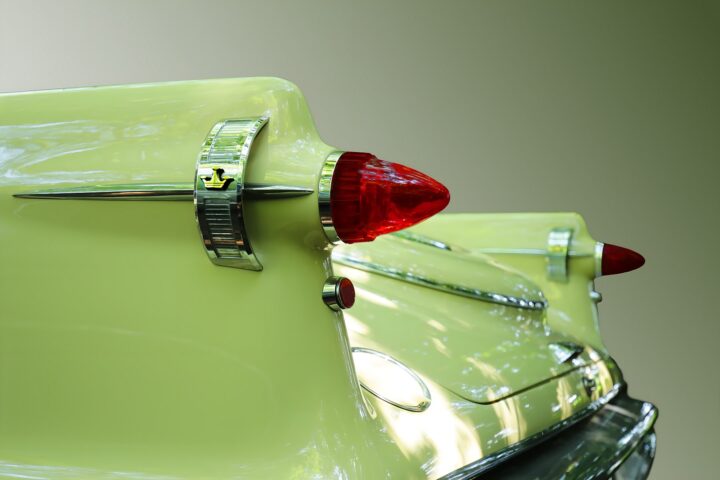
Between 1957 and 1963, Chrysler gave the Imperial a taillight that no other American automobile has ever matched for sculptural ambition, the gunsight taillight, a torpedo-shaped red lens mounted on a chrome ring that projects horizontally on a chrome blade from the fin tip. No concessions to practicality; every concession to drama. This 1959 Crown Southampton example wears the gunsight integrated into the fin in its rarest and most striking context: lime cream green paint that creates a near-perfect complementary contrast with the vivid red lens, and the Imperial Crown emblem in gold on the chrome collar ring confirming this is the top-of-line Crown trim level, Chrysler Corporation’s most prestigious offering of 1959 and its direct challenge to the Cadillac Eldorado at the summit of American luxury.
1959 Cadillac Coupe de Ville
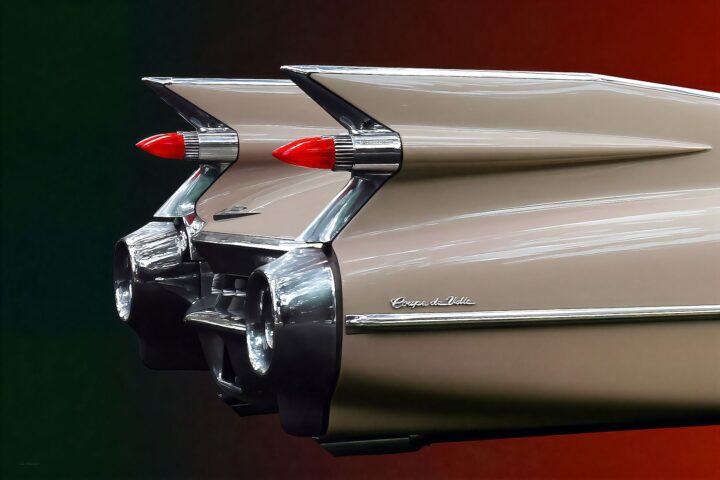
The 1959 Cadillac Coupe de Ville is the tailfin era’s defining image, a car so visually extreme, so absolute in its commitment to vertical drama, that it became the symbol of an entire decade of American ambition. The soaring twin fins, the chrome bullet taillights mounted at their very tips, and the wide, low body beneath them represent a moment in automotive design that could only have happened once. This photograph captures that unrepeatable peak with the detail and reverence it demands.
1959 Cadillac Sedan de Ville
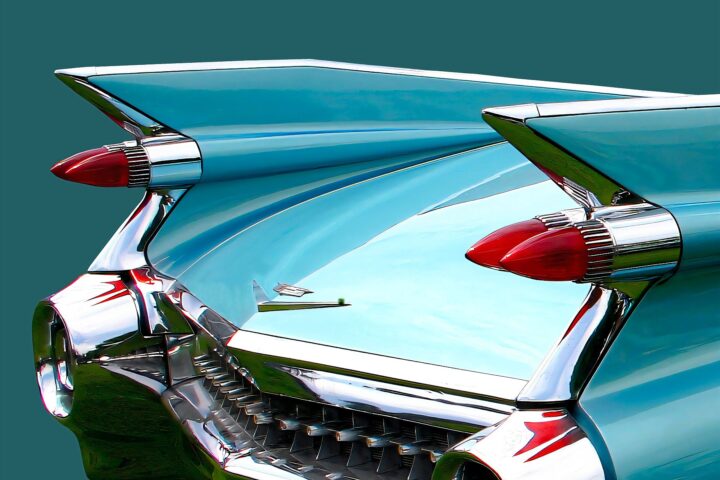
Where the Coupe de Ville makes the 1959 Cadillac tailfin argument in its most concentrated form, the Sedan de Ville extends the same extraordinary rear design across a longer, four-door body, creating an entirely different visual experience of the same iconic fins. The longer wheelbase adds a stately, almost ceremonial quality; the four-door roofline changes the proportions; and the overall effect is of a design that gains rather than loses as it grows. A companion piece to the Coupe that reveals the fins from a new dimension.
1959 Chevrolet Impala
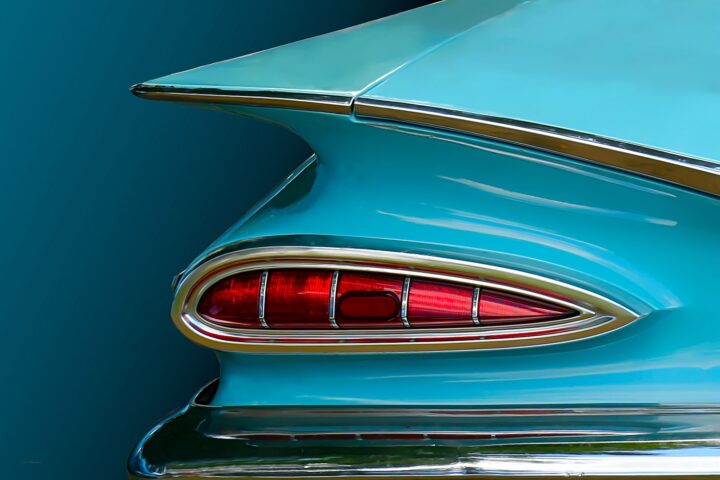
Often overshadowed in popular memory by the beloved 1957 and 1958 models, the 1959 Chevrolet Impala’s rear design is in many ways the most radical of the three — the wide, flat body, the distinctive gull-wing rear treatment, and the triple taillights creating one of the most unconventional and immediately recognizable rear views in American automotive history. This photograph makes the case for the 1959 Impala as one of Chevrolet’s greatest designs, and it does so compellingly.
1960 Chevrolet Bel Air
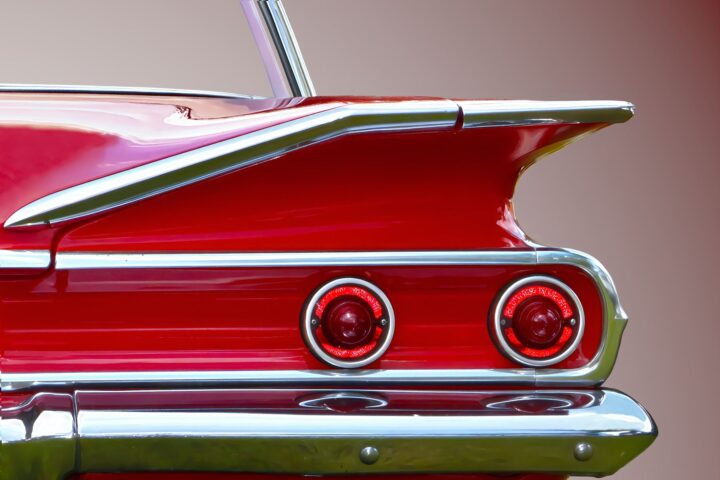
The 1960 Chevrolet Bel Air adopted a cleaner, lower rear treatment — the fins still present but far more integrated, the chrome still generous but more precisely placed. It is a transitional design that captures the precise moment when American automotive design decided it had gone as far as it needed to go. The photograph reveals how confident and well-resolved that retreat actually was. Sometimes the most interesting moment in any story is when the protagonist changes direction.
1960 DeSoto Adventurer
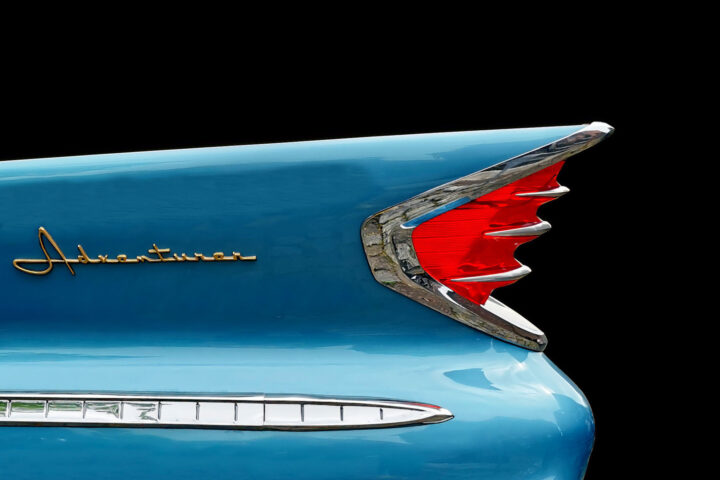
The 1960 DeSoto Adventurer was one of the last cars produced under the DeSoto name before Chrysler discontinued the brand later that year, and it went out in extraordinary style. The forward-facing fins, the complex taillight arrangement, and the dramatic rear quarter treatment are Virgil Exner’s Forward Look design at its most flamboyant finale. To photograph this car’s rear is to document a last act of great ambition, a brand’s final statement before the curtain fell.
1960 Ford Thunderbird
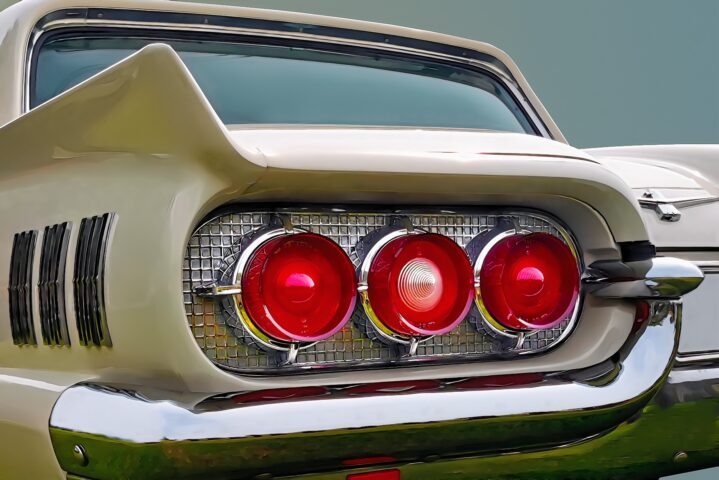
The four-seat Thunderbird of 1958–1960 – known informally as the Squarebird – took an entirely different approach to the fin formula: crisp, squared-off, almost architectural. The 1960 model’s taillights, set into a clean, wide chrome panel with precise geometric restraint, represent exactly the direction American design was beginning to move. It is a tailfin design that seems to be editing itself as you look at it — and it is all the more beautiful for that.
1961 Cadillac Coupe de Ville
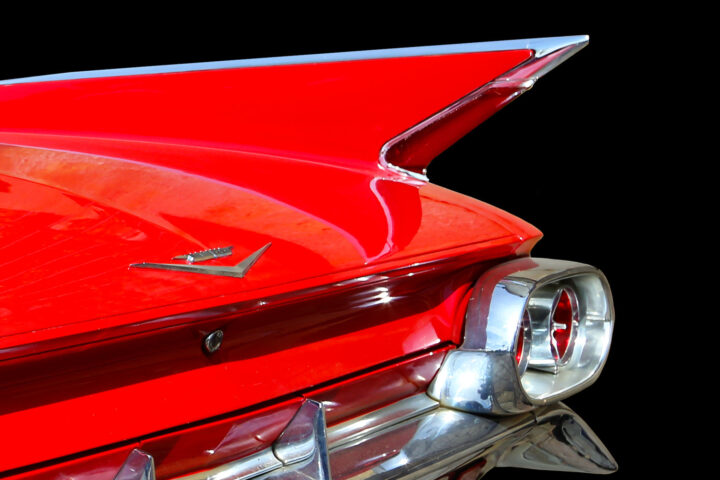
After the stratospheric heights of 1959, Cadillac began a deliberate and graceful retreat from excess — and the 1961 Coupe de Ville demonstrates just how elegantly it could be managed. The fins are lower and more swept, the taillights more refined, the chrome more purposefully applied. And yet this car’s rear still carries enormous presence and authority. Cadillac remained the standard of the world even as it changed direction, and this photograph shows exactly how it did it.
1961 Chrysler Windsor
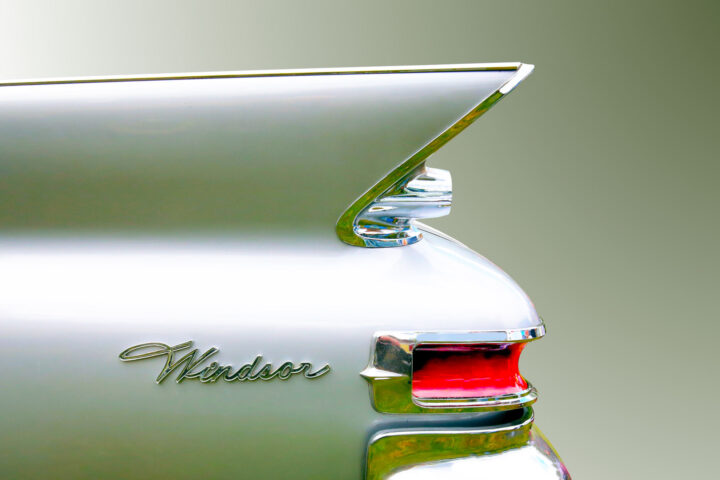
The 1961 Chrysler Windsor appears in the Kraaibeek Art collection for the second time – seen from the side of the rear on this page, where the transition between the Forward Look fins of the late 1950s and the cleaner design language of the new decade is visible in every line. The Windsor’s 1961 rear treatment is well-resolved and confident, showing a brand that had processed the lessons of the tailfin era and was ready to move on without regret.
1961 Studebaker Hawk
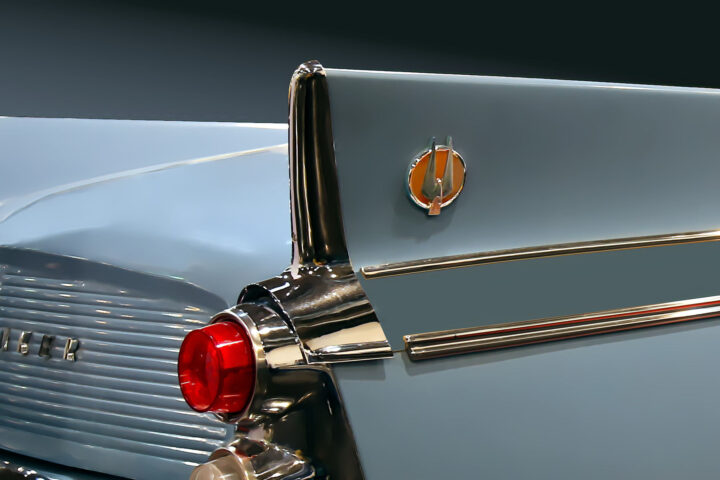
The 1961 Studebaker Hawk holds a unique place in automotive design history: restyled by Brooks Stevens on a minimal budget, it achieved one of the most elegant fin designs of the entire era at a fraction of the cost of the Detroit giants’ efforts. The clean, European-influenced rear treatment and the carefully detailed taillights speak of intelligence and restraint — qualities that made the Hawk a critical favourite even as Studebaker’s commercial position grew increasingly difficult. This is tailfin design at its most considered.
The Fin Fades – American Design Finds a New Direction (1962–1963)
By 1960, the era of maximum fin excess was already receding. Designers who had raced each other skyward for six years began a deliberate, elegant retreat — fins shrank, chrome grew more disciplined, and the clean horizontal lines that would define the 1960s began to assert themselves. But the eight cars in this final group are not diminished by that transition. They are, in many ways, more resolved and more sophisticated than anything that preceded them — designs that had learned what the previous decade had to teach.
1962 Cadillac Series 62
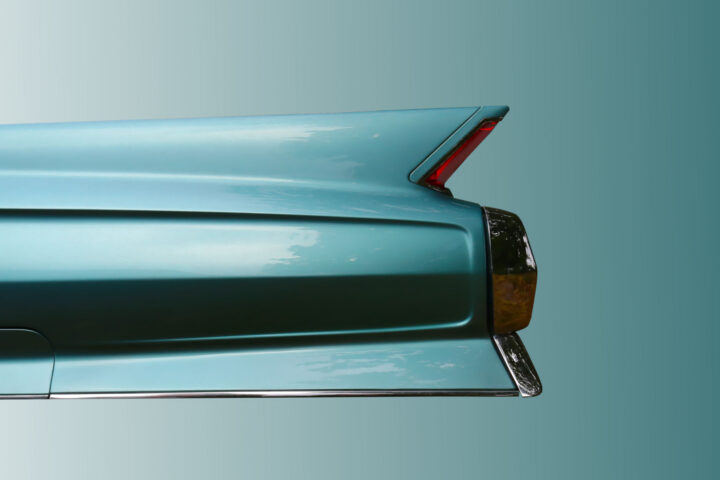
By 1962, Cadillac’s fins had reduced to near-vestigial proportions compared to the rockets of three years earlier — lower, softer, almost understated. And yet the 1962 Series 62’s rear design has a composed, authoritative quality that the more extreme designs never quite achieved. The taillights are elegant, the chrome measured and precisely placed, and the overall effect is of a brand that has found its confidence without any further need for spectacle. A masterclass in designed restraint.
1963 Mercury Comet Special S-22
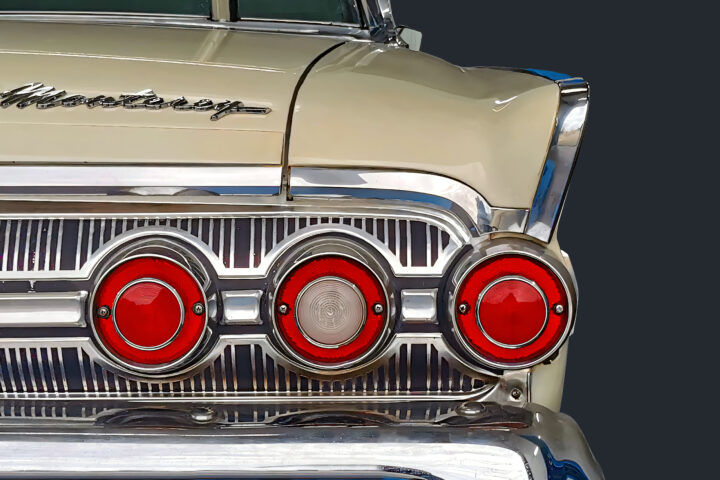
The 1963 Mercury Comet Special S-22 closes this collection at the very end of the tailfin story. It is a compact car with clean, horizontal lines and a rear treatment that makes no concession whatsoever to the drama of the preceding decade. The fins are nearly gone, the chrome is minimal, and the taillights are simple and purposeful. But look closely, and the taillights carry the faintest echo of everything that came before. It is a quiet, understated, and perfect ending to the most flamboyant chapter in the history of American car design.
SHOP THIS COLLECTION
Own a Piece of the Chrome Age – Fine Art Prints Available Now
Every photograph in this collection is an original, taken by Peter Kraaibeek and available exclusively through the platforms below. These are not stock images or licensed reproductions. They are unique documentary fine art photographs of rare and historically significant automobiles.
🖼 Fine Art Prints (Primary) Canvas prints, metal prints, framed prints, acrylic prints, and archival paper – in sizes from intimate to large-format statement pieces. → Browse the American Tailfins & Taillights Collection on Fine Art America
🖼 Also available on Pixels.com The same collection, on a different platform. Pixels.com is ideal if you already shop there. → View on Pixels.com
🎁 Gifts, Apparel & Merchandise Mugs, phone cases, tote bags, stickers, apparel, and more featuring your favourite fins. → Shop on Redbubble
⬇ Digital Downloads eBook High-resolution Art Book for personal printing. → View on Gumroad
📅 Classic Car Calendars (Coming Soon) Monthly wall calendars featuring the Kraaibeek Art classic car photography collection. → Wallartcalendars.com — Coming Soon
💡 A note on print formats for tailfin photography: Metal prints are particularly recommended for this collection. The aluminium surface interacts with the chrome details in these photographs — the taillights, the bumper chrome, the fin highlights – in a way that no other format can replicate. For maximum visual impact, metal print is the format of choice.
Why Tailfin Photography Belongs on Your Wall
The tailfin era lasted less than a decade. It was a moment of collective design confidence so specific to its time and place that it could never be recreated and most of the cars that produced it are now either in museum collections, privately owned, or gone entirely. A fine art print of a 1959 Cadillac tailfin or a 1957 Buick rear panel is not just decoration: it is a document of a design culture that existed for one brief, extraordinary moment in American history.
These photographs were taken with the same care and attention that a portrait photographer brings to a human subject. The chrome, the light, the color, the precise geometry of each taillight and fin are captured at full resolution, at the right moment, in the right light and printed at a scale that reveals detail you cannot see in any other format.
- For the car enthusiast – Gallery-quality fine art from the era you love, printed with the precision it deserves
- For the interior decorator – Bold, graphic photography with warmth, colour, and extraordinary visual detail – exceptional for living rooms, offices, studies, hallways, and garages
- For the collector – Original documentary fine art photography of rare automobiles, many of which exist in only a handful of surviving examples
- For the gift-giver – A deeply personal, memorable, and unique gift for anyone who loves the cars of this era
More in the Classic Car Photography Series
This tailfin gallery is part of a growing series of fine art photography collections dedicated to the details that make classic cars extraordinary. Each page focuses on a different theme, a different era, or a different country – and every photograph is original, taken by Peter Kraaibeek.
Already published: 🇺🇸 American Classic Car Dashboards & Interiors →
Coming soon: European Tailfins & Taillights · 🇮🇹 Italian Classic Car Dashboards · 🇩🇪 German Classic Car Dashboards · 🇬🇧 British Classic Car Interiors · 🏁 Racing Cockpits · 🏆 The Ultimate Dashboard Top 10
Follow on Pinterest to see new additions as they arrive or browse the complete Kraaibeek Art Gallery on Fine Art America now.
→ Follow Kraaibeek Art on Pinterest → Explore the Full Gallery on FAA