Splinter: The 2015 Supercar Built Almost Entirely of Wood
Every material has a story people think they already know. Wood, most people assume, belongs in furniture and cabins — not in a 600-horsepower supercar. Joe Harmon, an industrial designer from Mooresville, North Carolina, set out to prove otherwise.

The Splinter began as a graduate project at North Carolina State University, where Harmon researched wood’s largely overlooked qualities as a structural material — a better strength-to-weight ratio than steel or aluminum, and the distinction of being the only naturally renewable, biodegradable material used in automotive construction. Inspiration came from an unlikely source: the de Havilland Mosquito, a WWII-era fighter-bomber built almost entirely of wood that, remarkably, was also the fastest piston-driven aircraft of its era.
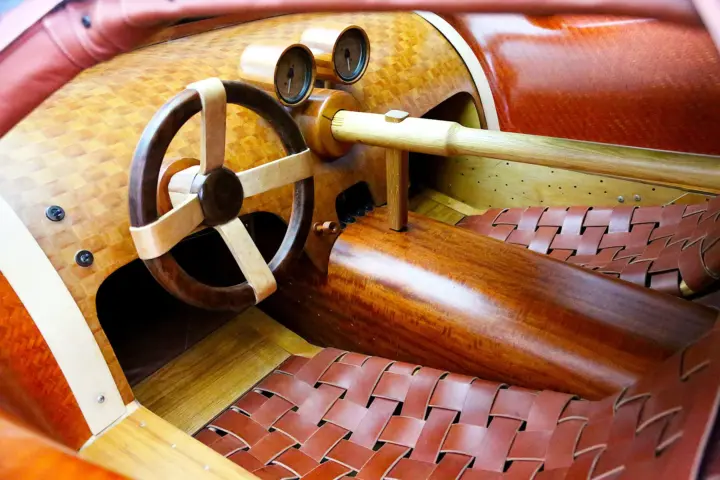
What followed was years of painstaking design and fabrication. The Splinter’s chassis is a laminated wood veneer monocoque. Its body panels are woven cherry skins over a tessellated balsa core. Even the suspension’s control arms and steering tie rods are built from laminated wood and hickory, and the custom-built wheels incorporate 32 layers of rotary-cut oak veneer, each spoke rated to withstand 6,000 pounds before snapping. In total, roughly 90% of the car — by Harmon’s own estimate — is wood or wood composite.
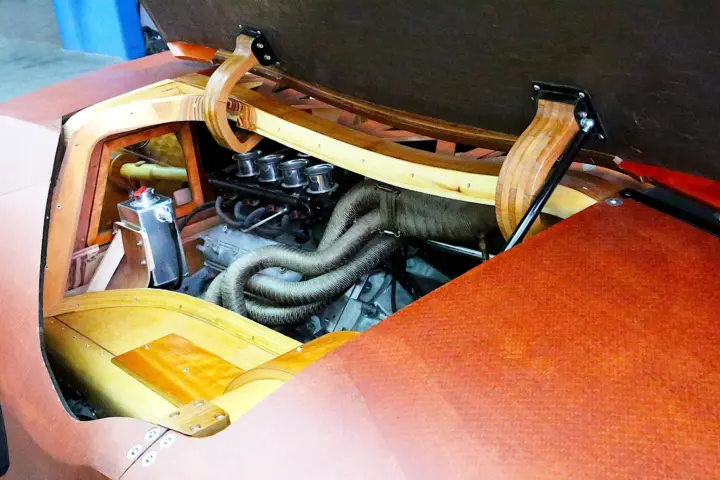
None of this comes at the expense of function. A mid-mounted, aluminum small-block V8, built from Chevrolet LS7 and CTS-V components, produces somewhere between 600 and 700 horsepower, paired with a six-speed manual transmission. The Splinter made its debut at the Essen Motor Show in December 2015, immediately drawing crowds curious to see whether a wooden car could really work. It was never meant to be sold — the Splinter remains a strict one-off, a design study built to change how people think about a material as old as the automobile itself.