Blitzen-Benz: The First Car to Break 200 km/h
At the turn of the 20th century, Benz & Cie. was the world’s largest car manufacturer, known for reliability rather than speed — but rival Daimler-Motoren-Gesellschaft was using motorsport success to eat into that reputation. Benz decided on a deliberate about-face: build the fastest car in the world, faster than any train or airplane of the era.
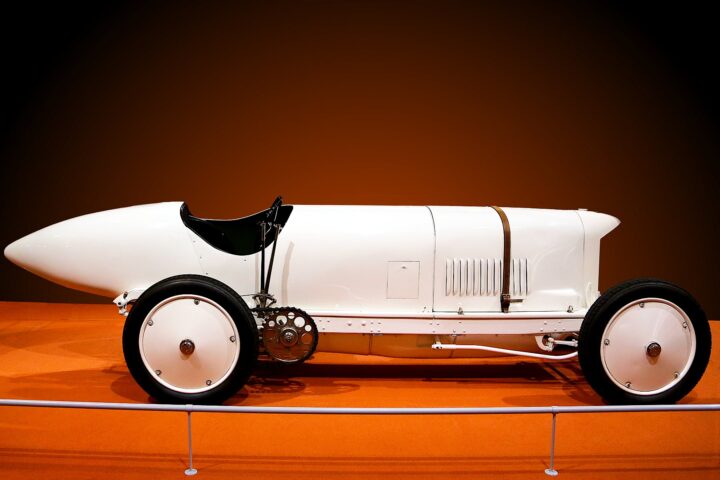
Work began in early 1909, starting from the engine of the Benz 150 hp Grand Prix racer. It wasn’t enough. Engineers enlarged the four-cylinder displacement to a staggering 21.5 liters, producing 200 hp at just 1,600 rpm from a power unit alone weighing 407 kg — to this day, the largest-displacement passenger car engine Benz or Mercedes-Benz has ever built. Following company convention of naming cars for their horsepower, it was christened the Benz 200 PS.
The effort paid off almost immediately. On November 8, 1909, works driver Victor Hémery took the car to the newly opened Brooklands circuit in England and recorded 205.666 km/h over a half-mile and 202.648 km/h over a kilometer — the first time any internal-combustion car had broken 200 km/h. American showman Ernest “Ernie” Moross bought one of the six examples built and toured it across the United States under a new name that stuck: “Blitzen-Benz,” German for Lightning-Benz. On March 16, 1910, driver Barney Oldfield hit 211.97 km/h at Daytona Beach; just over a year later, on April 23, 1911, Bob Burman pushed the same car to an absolute speed record of 228.1 km/h — faster than any car, train, or aircraft on Earth at the time, a record across all forms of transport that stood for eight years, until 1919.
Of the six Blitzen-Benz cars ever built, only two survive today — one held by the Mercedes-Benz Museum, the other in private American hands. It remains one of the true foundational icons of land speed record history, the car that first proved 200 km/h was possible at all.