Sin R1: Bulgaria’s Corvette-Powered Carbon Fiber Supercar
Bulgaria is not a country typically associated with supercar manufacturing, and that’s exactly what makes the Sin R1 worth discovering. Founded in 2012 by Rosen Daskalov, a Bulgarian engineer and former national karting racer whose father raced cars before him, Sin Cars began life building rolling-chassis race cars for private customers before taking the leap into a genuine, road-legal supercar.
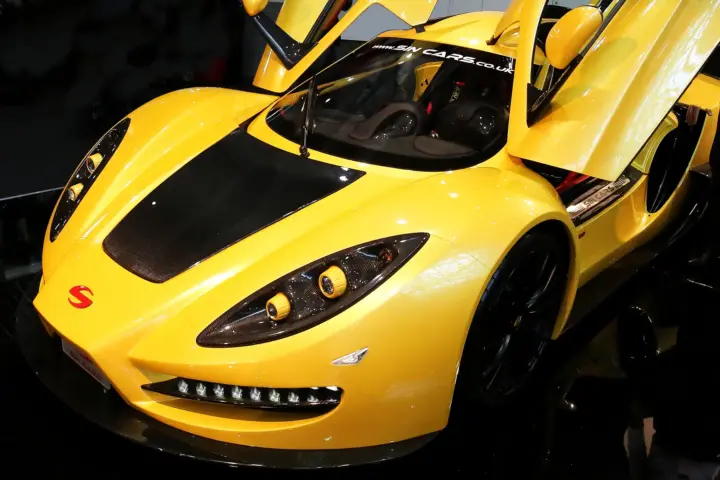
The R1 made its road-going debut at the 2015 Frankfurt Motor Show, though its roots trace back further, with a pre-production version first shown at the 2013 Goodwood Festival of Speed. Underneath its carbon fiber bodywork, built from Bulgarian-produced carbon, sits an FIA-homologated T45 tubular spaceframe chassis, the same foundation Sin uses for its GT4 racing program, which has competed in the European GT4 Series and Pirelli World Challenge. Power comes from a mid-mounted, Corvette-sourced V8, offered in three stages: a 6.2-liter LS3 at around 444-450 hp, a 7.0-liter LS7 at 530-550 hp, or a supercharged 6.2-liter LS9 producing up to 650 hp, paired exclusively with a six-speed manual gearbox and mechanical limited-slip differential.
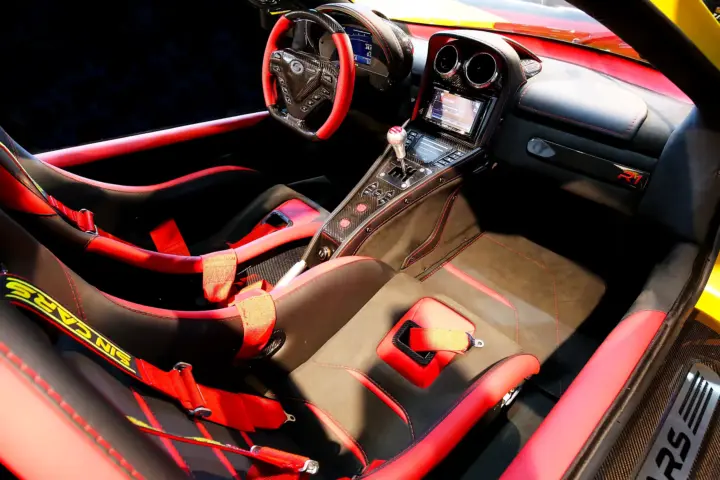
At a dry weight of just 1,250 to 1,300 kg, the R1 reaches 62 mph in as little as 2.5 seconds, depending on the engine chosen, with a top speed approaching 186 mph. Despite its race-bred underpinnings, Sin added genuine road-car comforts, including leather and Alcantara upholstery, electrically folding heated mirrors, and air conditioning, a rare concession to comfort for a car this focused. Photographed here with its dramatic upward-swinging doors open, the Sin R1 remains one of the few genuine supercars to emerge from Eastern Europe, built in small numbers by a company still proving that a serious sports car company can start from almost nothing.