Jaguar XJ220: Britain’s 213 mph Hypercar
Quick facts
- Built: 1992–1994, about 275 cars (sources say 275 to 282)
- Engine: twin-turbocharged 3.5-liter V6, 542 hp, 475 lb-ft
- Drive: rear wheels, five-speed manual
- Top speed: about 212 mph (342 km/h) at Nardò
- Price new: £470,000
- Designer: Keith Helfet
In 1992, Jaguar built the fastest production car in the world. It was low, wide, and sculpted, and it arrived just as the market for expensive cars collapsed. The Jaguar XJ220 is one of the most dramatic British cars ever made, and one of the most misunderstood.
From concept to production
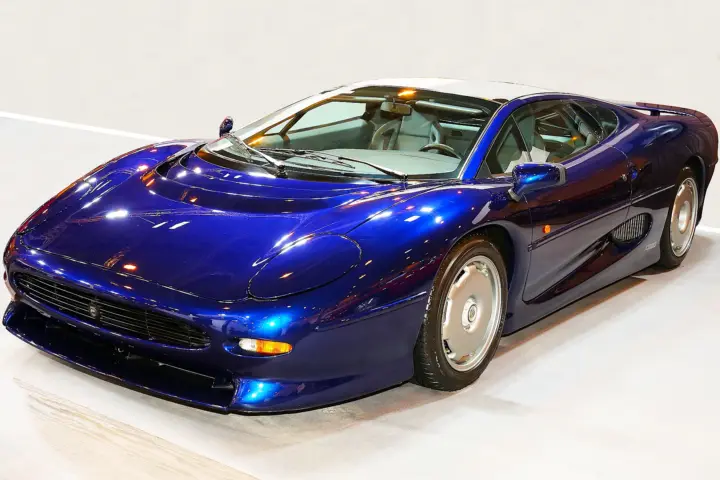
The XJ220 first appeared at the 1988 British Motor Show, designed by Keith Helfet. The idea came from Jim Randall, then Jaguar’s Director of Engineering, who built a model and brought it into work. A band of volunteers developed it as a skunk-works project to challenge the fastest cars on the planet. The concept was shown with a V12, and the public reaction was so strong that production was approved in December 1989, with Tom Walkinshaw Racing as Jaguar’s partner. The cars were built by hand in a new factory in Bloxham, Oxfordshire.
The numbers
The production car swapped the V12 for a twin-turbocharged 3.5-liter V6 producing 542 hp and 475 lb-ft, sent to the rear wheels through a five-speed manual gearbox and a twin-plate clutch. It accelerated from 0 to 60 mph in under four seconds. The name refers to the target of 220 mph. In testing, Jaguar recorded 341.7 km/h (212.3 mph) at the Nardò track in Italy, and in 1991 test driver Andy Wallace reached 213 mph in a pre-production car in Texas. The car is 4.93 meters long, 2.01 meters wide, and only 1.15 meters tall, and it weighs about 1,470 kg. Jaguar also says a prototype lapped the Nürburgring Nordschleife in 7:46, faster than any production car had managed before.
The wrong moment
The first customer car was completed in June 1992, at a price of £470,000. Jaguar reportedly took around 1,500 deposits of £50,000 each, but by the time the cars were ready, the recession had hit, and many buyers backed out. In the end fewer than 300 cars were built, and Jaguar kept dozens of unsold ones in storage for years. Production ended in 1994.
Supercar or hypercar?
By power alone, 542 hp makes the XJ220 a supercar. On this site it’s a hypercar because it held the title of the world’s fastest production car when it launched, until the McLaren F1 took the record. Jaguar itself describes the XJ220 as the fastest Jaguar ever produced.
About these photographs
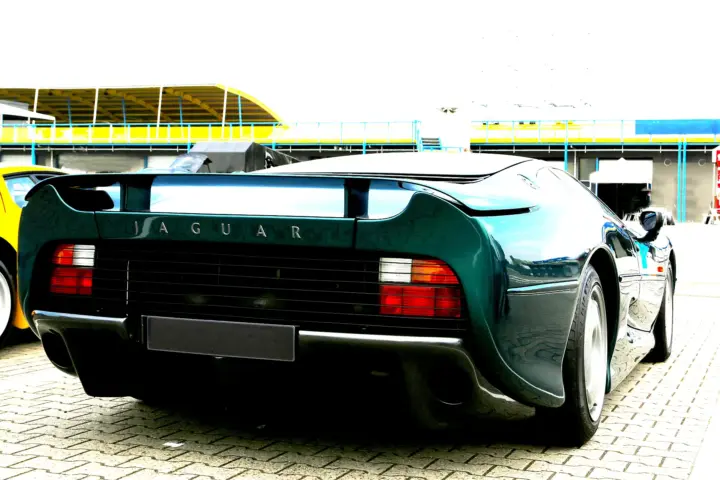
The blue car in the first photo is a 1993 XJ220 (shot at the 2018 Techno Classica Essen, Germany) and the green car in the second (shot at the Supercar Sunday 2014 at the “Cathedral of Speed”, TT Circuit race track, Assen, Netherlands) is a 1994 car, built in the final year of production.
Frequently asked questions
How fast was the Jaguar XJ220? About 212 mph (342 km/h) in Jaguar’s testing at Nardò, which made it the fastest production car in the world in 1992.
How many XJ220s were built? About 275, though sources give figures between 275 and 282.
Who designed the XJ220? Keith Helfet designed it, and it was built by Jaguar Sport with Tom Walkinshaw Racing.
How much did it cost? £470,000 when the first customer car was delivered in June 1992.