Italcorsa Tarf II: Taruffi’s Twin-Torpedo Record Car
Most engineers solve a problem by refining an existing shape. Piero Taruffi solved it by splitting the car in two. An Italian racing driver, engineer, and works driver for Mercedes-Benz, Ferrari, Maserati, and Alfa Romeo — later a winner of the 1951 Carrera Panamericana and the final Mille Miglia in 1957 — Taruffi held a doctorate in industrial engineering and used it to design his own record-breaking machines rather than simply drive them.
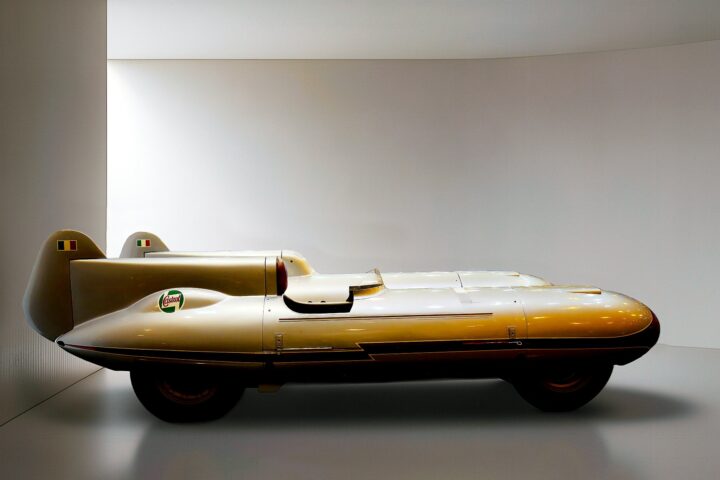
His concept, which he called “bisiluro,” Italian for “twin torpedo,” first appeared in 1948 as the Tarf I: two cylindrical bodies fixed side by side like a double motorcycle, one carrying the driver, the other a 500cc Moto Guzzi engine, riding on ultra-light Pirelli motorcycle tires. It set eight speed records in its class. Taruffi went further still, patenting a theoretical three-boom “trisiluro” for improved aerodynamics and visibility, though it was never built. What he did complete, in 1951, was the Tarf II — a refined successor that reversed the driver and engine positions and replaced the small Guzzi twin with a 1,720cc four-cylinder Maserati engine fitted with two-stage supercharging, producing 290 hp. With no space in the pod for a conventional steering wheel, Taruffi operated the car entirely by hand-operated control sticks, while adjustable tail fins compensated for crosswinds during high-speed runs.
On March 20, 1951, on the Via Appia near Rome, Taruffi drove the Tarf II to a pair of world records: 298.507 km/h over the flying mile and 290.552 km/h over the flying kilometer. He added five more records the following year, including a 50-mile average of 144.00 mph. Over the years the car’s mechanicals were modified repeatedly, at times running Ferrari engines instead of the original Maserati unit. The Tarf II survives today, having spent years on display in both Italian and Australian museum collections — a striking reminder of just how far a determined engineer-driver was willing to go in pursuit of speed.